Tag Archives: adventure

Is This My Future?

I’ve been a huge fan of Paul Theroux’s travel books, “The Great Railroad Bazaar,” “The Old Patagonian Express,“ etc. and have just finished “Deep South: Four Seasons on Back Roads” where he travels through the deep south of the United States. For me it doesn’t measure up to many of his earlier books, but at the end he wrote something I can identify as I approach three score and fourteen:

“Often, talking with someone in the South — a young farmer, a fifteen-year-old mother, a perspiring and potbellied policeman, an indignant gun nut, a toothy preacher, an idle college student, a genteel bank clerk, a harassed community volunteer, or an insulted citizen — I gathered from their response that I was speaking a different language, one that caused them to open their mouths in incomprehension and squint at me. At first I took it to be my Yankee manner, the affronted wanderer, the unlikely stranger with unexpected questions, someone to be appeased or placated.

“No, it was something else. It dawned on me slowly over months that to them I was an old man, who didn’t really count for much but who needed to be humored or grudgingly respected. This response made me mutter and shake my head, because I didn’t feel old. I felt — still feel — I am in the prime of life. But it’s wrong to say that aloud or to object; protestation is a grim old coot’s standard reflex. The hardest thing for anyone healthy to accept is increasing age. Yet why should you feel old if you’re not infirm? I was fit enough to drive all day, hundreds of miles, and to manage this trip; to be lost and to find my bearings; to endure abuse at times, to take the knocks and reverses of the road and a degree of skepticism or hostility from folks en route. Possibly some of them cupped their young hands and whispered behind my back, ‘De old man.’

“A news story I heard on my car radio gave me a clue. The announcer said, ‘An elderly man and a child were struck by a car late yesterday afternoon as they crossed Mabry Road near Highway 49 in Tutwiler,’ the sort of details that resolved themselves into the jerky afterimage of an unlucky man holding a child’s hand at duck, on the road, on foot in the heat — because the man was old and poor. Then more facts: ‘Warren G. Beaver, seventy-two and his granddaughter…’

“I laughed out loud and punched the radio off. Elderly!”

Is this how I can expect to be received if I buy a boat and cruise the Gulf Coast Intracoastal Waterway? Or sailing down the upper Mississippi? An elderly old coot?

3 Comments

Filed under Uncategorized

The Boat I Want and Why

About a year ago when my friend Stephen suggested I move back to the States and that we’d look for a boat for me to buy and live on I wasn’t ready to pick up sticks and leave Panama. But the kernel had been planted and I started mentally masturbating about what kind of boat I’d look for if I did make the move. The exercise begins by figuring out HOW the boat would be used.

If I were to return to the States I wouldn’t want to live on a boat stuck in a marina. Been there, done that. But I had a reason I was living like that…I needed to work to make money and survive. I survived but I didn’t make much money. I always had something going where I paid little to no rent at all for nearly five years. (Then I fell in love, moved ashore, and now both the bitch and the boat are gone…) Now, having retired and getting a Social Security deposit every month I don’t have to worry about survival any more.

So, if I was going to be on the move, where would I be going? Well, it’s something I’ve named The Great U.S. Inland Waterway Challenge. You don’t have to cross oceans to have nautical adventures. In fact, you don’t even have to go very far to have them, either. Unfortunately most people thing that “cruising” means traversing large bodies of water while fighting gale-force winds. Not so! Taking your boat to a lake or estuary and investigating parts of it you’ve never seen before is just as valid a nautical adventure as sailing single-handed around the world in a 10-foot boat.

There’s a ton of water-born adventuring to be done inside the boundaries of the United States. For instance there’s the “Great Loop.” That’s a circumnavigation of the eastern half of the United States by water.

loop

There are clubs, Facebook pages and internet groups devoted to this enterprise. They even have a website and burgee…http://www.greatloop.org

burgee

Well, I’ve got that one under my belt. In ’74, my first captain’s job I took a 43-foot Hatteras tri-cabin from Burnham Park in Chicago, went the lengths of lakes Michigan, Huron and Erie, out the Erie Canal, down the Hudson River and then did the entire 1,100-mile Atlantic Intracoastal Waterway single-handed. (Ive since run the Atlantic ICW four more times. Three times south and once south to north.) In ’75 I left Burnham Harbor with a couple on their 51-foot sailboat and we went down the Illinois and Mississippi rivers to New Orleans and then happened to end up at Bahia Mar marina in Fort Lauderdale, FL where I’d ended the voyage the year before.

What else is left? Lots. There’s the Gulf Intracoastal Waterway for an additional 1,000 miles. I’ve done a couple of little segments from Destin, FL to New Orleans and little parts of it in Louisiana when I was running inland crew boats around Morgan City, New Iberia and a few other sections.

Then, I thought, if I had a small enough boat that was easily trailerable I’d haul it up to Minneapolis and come down the Mississippi all the way to the Tennessee river, veer off there and take the Tennessee-Tombigbee waterway to Mobile. Already done that segment of the Mississippi from the confluence of the Tennessee to New Orleans in ’75. Coming down the river I’d have to stop a couple of days at Lock and Dam #20 in Canton, Missouri. It’s 30 miles or so north of Hannibal and the home of Culver-Stockton College that I attended for three years.

How about pulling the boat up to Pittsburgh, PA and going down the Ohio in the wake of those great shantyboat inspirations Harlan and Anna Hubbard? At least as far as the Mississippi once more. From there I could have it trailered to Sioux City, Iowa and run the 735 miles of the Missouri River.

So, what kind of boat would I need to do that sort of thing? Well, first of all it couldn’t be too big. It would have to be a “Trailer Sailer” with a retractable keel or centerboard so it would be easy to move around the great distances between, say, New Orleans and Minneapolis cause I’m not going to be able to sail against the current all that way, All along the Gulf ICW in Florida and Texas it’s SHALLOW so draft is a big consideration. My beloved Nancy Dawson drew four feet and so needed  five feet or better under her keel to do well. Many trailer-sailer have drafts as little as a foot and some even less than that.

Roaming around on Craigslist and other boat for sale sites I see that there’s a slew of trailer-sailer boats in the 23-foot range that can be picked up for under $2,000. When I brought this up to my friend Stephen he said, “Yeah, but wouldn’t you be more comfortable on something around 30-feet?” Well, probably! I’d also be a lot more comfortable on the 85-foot Jolie Aire that I ran over in France for three years, too. What’s your point?

I’ve mentioned in other posts about building a pilot house onto a small hull to give standing headroom in the cabin. I DO WANT to stand up when I’m cooking, at least, and to put on my pants.

But the best thing about a small boat in the 23-foot range is that it’s a LOT cheaper than a 30-foot boat.

In and around Fort Lauderdale dock rates are $1.50 to $2.00 per foot per day. So, for a 30-foot boat it would cost $60/night @ $2 and $45/night @ $1.50. For a 23-foot boat it would be $46/night @ $2 or $34.50/night. A difference of $15 or $10.50 at the buck and a half rate. Some of the marinas, though, charge on a minimum of a 30-foot boat no matter how much under that it actually is. Others charge at a 25-foot rate. Even that way it’s $50 a night @ $2 or $37.50.

So, let’s take the lower rate and assume, in all these numbers, that I’ll have to spend one week a month at a marina. The 30-footer would cost me $315/month. The 23-footer would be $241.50 a month, a $73.50 a month savings. Even at the 25-foot minimum rate the $262.50 is a $52.50 savings on my $1,100/month SS check and equals 17.5 gallons of gas @ $3.00/gal. Assuming I can get 12/miles per gallon that one month savings at the lowest amount will get me roughly 210 miles further up the river.

Of course I wouldn’t be spending much time at a dock in Fort Lauderdale to begin with. So let’s take a look at an out-of-the-way place like Steinhatchee up in the Big Bend area of Florida…

At Riverhaven marina in Steinhatchee, FL, up in the Big Bend area of the Gulf Coast, the cost for an uncovered slip is 50¢/foot a day. So, easy-peasy, a 30-footer would go for $15/day. The 23-footer would be $11.50/day or $3.50/day savings. No big deal. But the weekly difference would be $24.50 or, over a year that’s $294. That would be 98 gallons of gas @ $3 gal. or 1,176 miles under the crank-up keel.

Let’s say I wanted to spend the winter months up there. The monthly rate is quoted at $149.50 and for a four-month stay it would set me back just under $600. Not bad when you consider that my half of the duplex rent when I lived in Fort Lauderdale six years ago was $600/month.  In fact, the monthly rate at this marina would be just half a buck short of what I’m paying for rent in Boquerón.

So, let’s go over to Texas since I plan on running the ICW all the way to Brownsville…

In Corpus Christi, at the Corpus Christi Marina short term slip rates are $1.50/ft. = $34.50/night for 23-footer and $45 for the 30-footer.

Across the way at Islands Moorings in Port Aransas doesn’t matter if it’s 23-foot or $30 the rate is $35 per night for vessels up to 32 feet and then they’re gonna nick ya $7 to hook up to 30 amp electricity. At the end of the line in Brownsville and South Padre Island there are several marinas but most don’t list their rates. It’s sort of a “Surprise, you can’t afford to be here…” situation. The one place that DID list a rate for transient dockage is the Sea Ranch Marina at South Padre Island and 23’ or 30’ or any feet it’s $65/night though they’re generous and throw in the electricity at that price. And people wonder why I’m so inclined to say TUCK FEXAS!!! But if I want to complete The Great U.S. Inland Waterway Challenge gotta go there.

In 11 days I find out if my new choppers are going to fit. If they do, I’ll give it a month to make sure they don’t need to be adjusted and if all’s good to go then I’ll be having my 74th birthday party in Fort Lauderdale. (July 9th)

Comments Off on The Boat I Want and Why

Filed under Uncategorized

Setting Priorities

When I get back to the States sometime around July I want to buy something like this —

catalina

Why? Primarily because they’re cheap to buy. This one has an asking price of $3,500 and if you look on Craigslist you’ll find a lot of these “trailer sailers”some with asking prices of $1,500 or less.

It’s easy to see that a boat like this sure doesn’t have much headroom inside. Many of the builders eased that a bit with the creation of “pop tops.”
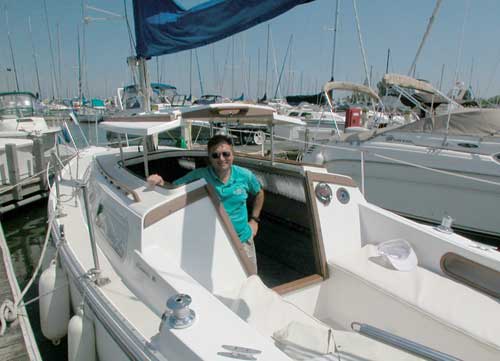
Catalina25_poptop2

These give close to 6-foot headroom in much of the cabin. Of course you’ve got all that open air space between the top and the cabin. Not real good when it’s raining or you’re somewhere where it’s buggy. But they do make canvas fixtures that enclose the cabin.

cover


Several downsides to something with this. First, you can’t use it while underway. Second, can you imagine what a pain in the patootie it would be putting this thing on every day if you’re out cruising? And taking it down. And doing it when the wind’s blowing like stink. Or it’s raining. No thanks.

So I’d want to build a pilothouse that would cover where the pop top was in the first place and make it attractive.

20492-5746723

That pic is of a Compac 23, but it wouldn’t be that hard to do with glass over foam. My friend, Stef, and I could do a good job of it.

BUT, one of my goals upon returning to the States and getting a boat is to go “adventuring.” The first thing I want to do is run up the ICW and go explore the St. John’s River and then return to Ft. Lauderdale for the first Thanksgiving dinner in seven years.

That means setting priorities. One thing I learned long ago as a professional yacht captain is that if you wait for everything to be “just right” you will never get off the dock. There are some things on your “to do” list that don’t have to be done before you leave. They can be done along the way. Building the pilothouse isn’t one of them, of course but it can wait since it’s not essential for making the trip, just for making it more comfortable.

Every boat comes with some extras that simply aren’t mentioned in the ads. Things like compasses, fenders (you lubbers call them “bumpers”) docking lines, life jackets, etc. Usually, but not always. I’ve given this a lot of thought about what is essential in order to make my first cruise.

REQUIRED

The Coast Guard mandates that boats carry certain equipment when underway. Some things are required on ALL boats no matter what their size, but mine will be less than 26 feet so I’m just going to list what I’LL need to have…

Recreational boats must carry Coast Guard approved Personal Flotation Devices, in good and serviceable condition, and of the appropriate size for the intended user. Wearable PFDs must be readily accessible, not stowed in bags, locked or closed compartments or have other gear stowed on top of them. Throwable devices must be immediately available for use. There must be one Type I, II, III, or V PFD for each person on board or being towed on water skis, etc., PLUS one Type IV throwable device.

This is a Type II life jacket and is for “inshore” use and since I’ll only be cruising the ICW (Intracoastal Waterway) this is all need. I’ll carry three so I’ll have some if I want to take a couple of people along for an afternoon.
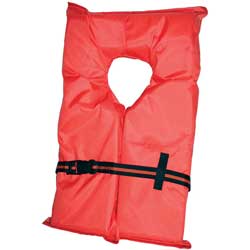
Type II

A “throwable” device could be one of these.

throw

vest


Each vessel is required to have a “throwable” floating device: throw

I’ll probably get one of these for myself. It’s a “Coastal Automatic Inflatable Life Vest… cuz with a small boat like the one I’ll be on you never know when you might end up in the drink and this type is light and non-restricting.

vest


This is kind of “iffy.” You’re supposed to have at least one B-1 type Coast Guard-approved hand portable fire extinguisher.
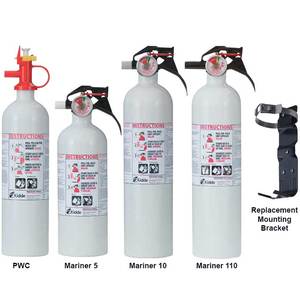
fire

Where the “iffyness” comes in is that they’re not required on outboard boats less than 26 feet long and not carrying passengers for hire if the construction of such motorboats will not permit the entrapment of explosive or flammable gases or vapors, and if fuel tanks are not permanently installed. I’ll be a “sailboat” not a motorboat. I’ll be under 26 feet long and I won’t be carrying passengers for hire. Also my fuel tanks won’t be permanently installed. I WILL, though, be cooking on board with propane and one would be really stupid not to have a fire extinguisher. In fact, you should probably have one in the kitchen of your HOUSE. Flash fires from cooking oil or bacon fat are not unheard of.

All boats are required to carry visual distress signals approved for daytime and nighttime use. For pyrotechnic devices (hand-held or aerial red flares, floating or hand-held orange smoke, and launches for aerial red meteors or parachute flares) a minimum of three required, in any combination that totals 3 for daytime and 3 for night use. Three day/night devices will suffice. Devices must be in serviceable condition, dates not expired and stowed accessibly. Again, running in the ICW makes having these kind of a waste of money, but you HAVE TO HAVE them, soooo.

Every vessel less that 39.4 feet (12 meters) long must carry an efficient sound-producing device: a bell or a whistle. COLREGS (The International Regulations for Preventing Collisions at Sea) have specific rules about sound signals that vessels are required make in foggy conditions. Horn signals if the boat is underway, and bells if anchored. A horn isn’t strictly required but is a “must have,” in my opinion, in order to signal bridges that need to be opened and to  signal other boat of your intentions when underway in passing situations.

Now, just because you have all that on board doesn’t mean you’re ready to leave the dock and go cruising…In addition to the stuff that’s required there are still the…

ESSENTIALS 

In no particular order of importance, you’ll need to have:

At least four lines to secure the boat to a dock. It’s also a good idea to have a couple of others in reserve since it’s not unknown to leave on on the dock from time to time. One should also carry about 100 feet of extra line, just in case.

Your boat also needs to have running lights to comply with COLREGS if you get caught out after dark. You also need to have an all-around white light to show if you’re anchored. As far as the anchor light is concerned I’m really thinking of getting two or three of these…

lights

http://www.amazon.com/Backpacking-Rechargeable-Collapsible-Waterproof-Lightweight/dp/B00Y82IHWE/ref=sr_1_2?ie=UTF8&qid=1461089445&sr=8-2&keywords=suaoki

When I first ran across them somewhere in my net surfing I thought they’d be great as anchor lights and for interior lights as well. A couple I know who recently settled in nearby Boquete did some extensive cruising that encompassed the Pacific coast, a passage through the Panama Canal and Caribbean cruising said they has some of these and they loved them.

A VHF radio, either a base station or a hand held is essential. You need them to contact bridges you need to have opened. You need them to contact the Coast Guard in case of an emergency. You need them to hear local marine weather notices. You need them to talk to other boats.

An anchor. TWO actually. One as the principle anchor and a smaller, lighter one as a “lunch hook” for temporary anchoring or in cases where currents turn with the tide. What you do in that case is to drop and set your main anchor, let out double the scope you need at that spot and then drop and set the second anchor. When you’ve done that you pull yourself back to where you’d have been after dropping off the first anchor and secure both. Now, as the current changes direction you’ll ride to the second anchor rather than swinging in a big circle possibly dislodging the single answer and be dragged to some place you don’t want to be.

You’d also use two anchors close in to shore. As you approach the shore you drop one of the anchors and let out rode until your bow touches the beach. Step off into the shallow water, take your bow anchor and embed it deeply some distance up from the high water mark. Now, pull back on the stern anchor line until your sitting comfortably and secure both anchors.

Use PLENTY of chain between your anchor and rope rode. ALL CHAIN rode is best, but you’re not going to be able to carry enough of it around on a 23 foot boat! Curiously my Kaiser 26 had 200 feet of chain rode. The simple weight of it was often enough to keep the boat in position. I vividly remember anchoring off of Ranguana Caye on the outer reef in Belize. I was in six feet of water and let out 60 feet of chain. Whenever possible I dove down to make sure the anchor was well dug in to the bottom. As I swam along in the crystal-clear water I noticed that the chain was lying in an “S” shape about 2/3rds of the way to the anchor. The anchor wasn’t well dug in. It was a rather large Danforth and the flukes were only half way dug into the sand. Problem was they wouldn’t go in any further since it was simply a thin layer of sand over coral.

In the middle of the night a strong squall ripped through the area. There was lightning and heavy rain. The wind was piping at who knows how fast, but the rigging was moaning a low tune. I got up, went on deck towards the bow trying to ignore the rain pelting my skin like evil little imps taking chunks in nasty bites. I let out probably another 50 feet or so, secured it and went back below to my bunk. In the morning I went over the side and swam along the length of the chain. As strong as the wind had been it hadn’t moved the boat enough to straighten out the chain and the “S” was still there, so the strain never reached the anchor itself.

For me, I’ll probably limit the amount of chain I use to no more than 15 feet before connecting it to rope rode. Chain’s heavy, and it’s really going to be rough for me with my COPD to haul that chain and a 25 pound anchor off the bottom and onto the boat. It has to be done FAST because I’ll be by myself almost all the time and once the anchor breaks free from the bottom I’ll be adrift and need to get to the engine and tiller ASAP!

I was lucky on Nancy Dawson since the boat was equipped with a windlass to haul the anchor.Mine was a Simpson-Lawrence but looked a lot like this.

winch

It was mounted on the bow just aft of the bowsprit. You put a winch handle in the hole on the top and cranked away. It was fairly easy though there were a few times when the wind was blowing and I had to haul the weight of the boat against the force of the wind. (A little aside: I see many sailboat boat ads that say the boat is equipped with “wenches.” not “winches.” If they really WERE equipped with wenches I bet they’d sell in no time.)

A motor. On boats like this it’s generally an outboard. A 9.9 hp is generally the maximum and I’ve seen a lot of ads for these trailer sailers that have a 5 hp outboard with them. I’m sure that would push the boat along quite well since they’re rather light not lugging around a huge heavy lead-filled keel.  My Nancy Dawson had one of those keels and she was also built like a tank. She had an 8 hp Suzuki outboard that did double duty as power for the mother ship and for the Avon dinghy, and it did quite well. I’d hope for a 9.9 simply because I believe I’d get better mileage since the engine wouldn’t be pushing so much weight you could run it at a lower throttle setting and save gas.

Almost every one of the boats advertised has sailing gear. Mast, sails, rigging, etc. That’s nice, but I don’t intend on using it. What I’d want to do is scrap the tall mast and rigging and replace it with a free-standing mast that would carry a lug sail like this…

lugsailcruiser

I’d go for something even smaller than that rig. Ninety nine point nine percent of my cruising is going to be in very constricted waters like the ICW and a sail would only be used with the wind abeam, from astern, or on the quarter, and then just to be able to ease up on the outboard’s throttle. I’m done beating into the wind. If I have to go to windward ever again it will be under dead dinosaur power only. AND what I would do for a sail, at least initially, would be a polytarp contraption like this…
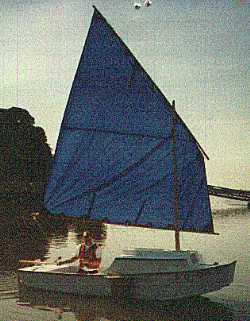
sail

Hey, don’t laugh and don’t forget, I’m doing this on the cheap!

So why scrap the original mast? First, because most of my future cruising is going to be on the ICW I want to open as few bridges as possible, and there are a TON of bridges you have to have open for you when your air draft is 30 feet or higher. I’m thinking of a mast around 20 to 25 feet high in a tabernacle that I can raise and lower in a couple of minutes by myself. Also, being in a tabernacle I could lower it and support on a boom gallows so I could cover it with a boom tent to enlarge my sheltered living space while at anchor or docked.

A nice to have feature, but not an “essential” would be a Bimini cover in the cockpit.

I’m kind of on the fence as to whether a dinghy is an essential or a nice to have. Dinghies are the pickup trucks of cruising boats. They ferry people to shore when the boat is anchored and haul supplies to the anchored boat from shore. They’re also good for visiting other boats in the anchorage and for exploring little creeks where the big boat can’t go. But since I’m going to have a boat that has such shallow draft that I can simply step ashore in ankle deep water, and if I DO have to anchor out it will only be for a night or two at best so why would I need a dinghy.

But if I have a dinghy it WON’T be an inflatable, unless it’s part of the package when I buy the main boat. Inflatables have several bad features. For one, they’re targets for thieves. The damned things are prone to leak air and deflate, and there are a lot of little vandals who like to stick the tubes with something sharp just for fun. Because the primary boat is going to be so small my ideal dinghy would be something like this…

dinghydinghy2

I’d also consider making a Puddle Duck Racer that could be “nested” like the dinghy above. The PDR can be rowed, handle a small outboard or sailed. There are even plans for a modular PDR…I’ve loved the concept of this boat from the first moment I laid eyes on it.

Click to access ModularPDR.pdf

I like the idea of building it with foam and glassing it over. Lightweight, and if made modular it would fit neatly on the foredeck without disrupting the trim too much.

One thing to consider about a dinghy is to make it unique. Make it stand out from the crowd either by design or by painting it some atrocious color so that only an idiot would steal it because it would instantly be recognized as being stolen.

A rain water collection system I would consider an essential so you wouldn’t have to depend on going ashore to a marina to fill water jugs. There are umpteen million ways this could be done, of course so I won’t get into trying to list them, but this is how I did it on Nancy Dawson when I was on my nine-month cruise.

I used some of that epoxy stick I mentioned earlier and built about a two-inch high dam between the cabin and the toe rail astern of the water tank fill, leaving about a four-inch gap so water could flow through unhindered to the scuppers. When it would start to rain I’d let it go for five minutes or so to rinse off the cabin top and the decks. Then I’d plug the gap with a dish towel and open the water tank fill. In a good hard downpour I could fill that 35-gallon tank in about five minutes. During the whole cruise I probably didn’t go ashore for water more than three or four times.

Compass? Most boats will come with one screwed into a bulkhead, but even if there isn’t one on the boat do you think it’s vital when you’re cruising in waters like this…

chart

 If you can’t figure out which way north and south are, here, you shouldn’t be out in a boat in the first place. Which reminds me of a story. (LOTS of things remind me of a story.) Back in ’68, shortly after my ex wife an I moved to Fort Lauderdale I was driving a cab while looking for another job. One afternoon I was sitting outside one of the hotels on the beach waiting for a fare when a car pulled up beside me and asked how to get to such and such a place. I said, “Go north for about…”

“Which way is north?” the tourist interrupted.

Jesus fucking Christ nailed to a stick. Have you ever seen a fucking map of the United States in your entire life? We’re sitting right on the edge of the whole damned continent. Another hundred feet or so and we’d be in the damned Atlantic Ocean and you have to ask which way north is?

Anyway, I consider a pair of binoculars to be an essential item. You need it to pick out crucial buoys and day markers when you approach inlets with a profusion of markers.

That’s about all I can think of off the top of my head right now so I’ll stop. Things that I think are nice to have but non-essential gear will be dealt with later.

1 Comment

Filed under Uncategorized

$3 Three-Hour Diversion

Since deciding that I need to leave Panama and return to the U.S. I’ve also decided that I need to play more “Bus Roulette.” That’s where I simply get on a bus and see where it ends up.

When I go to Bugaba, the nearest town to Boquerón to do a little bit of shopping I have to go down to El Cruce where the Boquerón road intersects with the Interamericana, I usually get on the Divala bus since, for some reason, there always seems to be an empty seat. But until this morning I’ve never been there. So I went down and hopped on. Didn’t get any pictures, but here’s what I saw…

It’s flat down there on the other side of the Interamericana.

Divala is a LOT bigger than Boquerón. Probably 3 times the size, at least.

Lots and LOTS of indigenous people live there. It seemed that nearly all the school kids, and they were EVERYWHERE in their white shirts and blue pants and skirts as there were four schools that I saw in the area, were Indians.

People were WALKING all over the place. Only saw ONE taxi where there’s probably close to a dozen serving the Boquerón, Macano and Bocalatun area. And BIKES! Seems that half the population of Divala rides bicycles.

The houses aren’t nearly as prosperous as here in Boquerón, though here and there were nice houses surrounded by hovels, at least 25% if which had outhouses off to the side. Bamboo grows all over the place and I saw close to a dozen houses that were made out of the stuff.

I was gone for 3 hours and the bus fare was $1.50 each way.

Divala

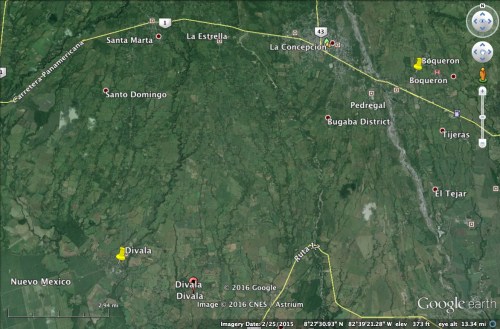
The pic below shows where Divala is in relation to Boquerón…the yellow pin upper right.

Divala big pic

Comments Off on $3 Three-Hour Diversion

Filed under Uncategorized

The Next “Good Adventure”

So, as you know, I’m leaving Panama. It was a “Good Adventure” six years ago, but it isn’t anymore, alas, alack. I’m waiting to have some serious dental work done before I leave, so it’s probably not going to be before early summer at the soonest, but it’s not too soon to be thinking about where this next “Good Adventure” is going to take place.

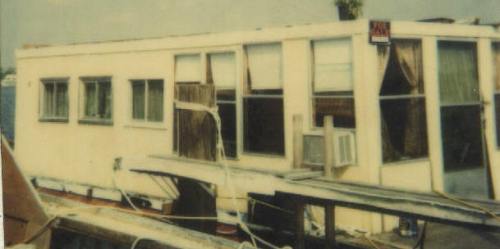
Initially I’ll be returning to Fort Lauderdale. It was home for some 35 years off and on. There were diversions, of course. A nearly 10-year stay in New Orleans that included close to three years on a shantyboat I found tied up to a tree in the Tchefunctae River on the north shore of Lake Pontchartrain and bought for $1,500. The boat, not the tree, the lake or the river, just to be clear.

Houseboat trimmed

Then there was nearly a four-year sojourn that included running this boat out of Antibes on the French Riviera and Marbella, Spain for almost three years,

Jolie Aire-Golfe Juan

and then buying my beloved Nancy Dawson, a Kaiser 26, and taking off for nine months and traveling alone on her to Mexico, Belize and the Rio Dulce in Guatemala.

Nancy Dawson

In Lauderdale I’ll be looking to buy a small sailboat and leave as soon as possible. The question, of course is, “and go where?”

Several places easily come to mind. They are, in no particular order, especially since the seeds are simply germinating now:

The Saint John’s River in northern Florida. When my mom died in 1976 my dad took his two toy poodles, boarded his 26-foot Stamas in Venice, FL and disappeared for six months. No one had any idea where he’d gone. Turns out he’d taken the Okeechobee Waterway across the state, hung a left and went up to the St. John’s where he did his mourning. I have an email friend who built a shantyboat that he charters out up there on the river…http://www.shantycraft.com

shantycraft


I have done what they call “The Great Loop” in ’74-’75. It’s a circumnavigation of the eastern half of the United States. A great adventure but I don’t need to do it a second time.

Great Loop

Both times I left Burnham Harbor in Chicago and ended up at Bahia Mar Marina in Fort Lauderdale. (The end spot was just coincidental but cool since it definitely closed the circle.) Looking at this map you see that the river route splits at the Illinois/Kentucky border. The yellow line is the Tennessee-Tombigbee Waterway route. It was just a pipe dream in ’75 so we went all the way to New Orleans on the Mississippi. I went UNDER every bridge in the New Orleans a year before I went over any of them!

Looking at the map above just gave me another idea…why not do a “Small Loop” and travel UP the Tenn-Tom, as it’s called, and return DOWN the Mississippi?

Then there’s the Intracoastal Waterway. There’s over 3,000 miles of it starting at Mile 0 in Norfolk, VA and then all the way down the Atlantic seaboard to Miami and then the Gulf Coast from Fort Myers to Brownsville, TX.

ICW-Atlantic Map ICW-Gulf Map

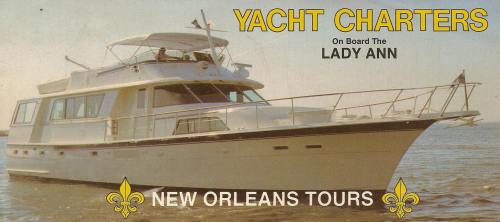
I’ve done the Atlantic Coast portion a half dozen times. The very first time I did it solo on a 43-foot Hatteras tri-cabin in ’74 that I delivered from Chicago to Fort Lauderdale. On the Gulf Coast ICW I’ve only done portions. I ran a Hatteras motor yacht in New Orleans for several years. The owners had condos over in Destin, FL and when they went there they liked to have the boat sitting at their dock sort of as bragging point to how wealthy they were.

Lady Ann-Hatteras 58

So I’ve done the portion from NOLA to Destin a half-dozen times, too. Then, when I was running inland crew boats for a few years I did portions of the Gulf ICW from Houma, LA and as far west as Grand Lake, LA. Perhaps I should take my new boat over to Ft. Myers and do the whole Gulf ICW to Brownsville. That would be a clean sweep of the waterway.

As you look at that map of the Gulf Coast ICW you see a break in the yellow line. That’s called “The Big Bend” and it’s an offshore jump of about 140 miles. In between is called Florida’s “Hidden Coast.” It’s very shallow all through there but there are a lot of places that would be worth poking into, like the Steinhatchee River and the Suwannee River. That’s right, the one Steven Foster wrote about!

Finally, and this would entail some real expense, it would be kind of neat to truck the boat up to Minneapolis  and come down the Mississippi. It would be a kick stopping for a couple of days at Lock and Dam #20 which is in Canton, MO where I went to college for three years. As I got close I’d send press releases saying that a former alum was coming down the river on a boat. I wouldn’t have to go all the way down to New Orleans, though. I could hop on over to the Tenn-Tom and go down to Mobile on it.

There are a ton of possibilities. Which of these do you like best?

1 Comment

Filed under Uncategorized

Packing It In – – Leaving Panama

I never thought I’d say this, and it pains me deeply, but I’m leaving Panama. Calling it quits. Packing it in. Returning to the States.

It won’t be for a couple of months but I’ll most likely be celebrating my 74th birthday in Florida.

Why am I doing this? It’s difficult to put things in any kind of orderly, coherent fashion, so this post is going to roam all over the place, but it’s primarily health concerns that are the reason. I have a serious case of COPD and though I take meds for it breathing is sometimes a real issue. Recently I had an incident that made me decide to take my old and best friend, Stefan, up on his mantra of the last couple of years, “Come back here. We’ll find you a boat you can live on and you can enjoy life again.”

It’s not that I haven’t been enjoying my life here in Panama. I DO. I love this place, but really, when I think about it, I’ve pretty much just been sitting around here waiting to die. So what finally made me decide to act on Stef’s offer? Well, the other day I headed out to the nearby tienda to get something cold to drink. It’s about 50 yards away from my front door, but when I got there the place was closed. So I decided I’d head to the Chino, Panama’s answer to the 7-11, which is about a hundred yards up the small hill past my house. When I got back to my house from the tienda I had to stop and rest for about five minutes to catch my breath. (I didn’t have my Ventolin inhaler with me.) When I got up to the Chino I was panting so hard that I had to sit down on a bench at the park across the street until my breathing returned to normal, and I sat down and rested after buying a couple of quarts of orange juice before walking back to the house. That did it. The decision was made. (More about health in a moment.)

Another issue is “What am I doing here?” The name of this blog is “One More Good Adventure.” Well, I haven’t been doing any adventuring for the last several years. The initial move down here was certainly an adventure. My original idea was to come down and build a shantyboat over in Bocas del Toro and then spend the rest of my life poking around that beautiful archipelago. Obviously that didn’t happen for many reasons that I’ve listed in previous posts and the fact that inertia is hard to overcome.

Another expat who moved down here from Sarasota with her husband, Kris Cunningham, is another inspiration for my decision to leave. She’s a 63-year old woman off on a real adventure. Recently she got on a plane and flew to Seattle, Washington, to visit her daughter and grand daughter. No big deal, right? Well, the thing is, she took her bicycle up there with her and plans on riding it back to Panama! And what am I doing with my adventure???

So, back to health. One thing all of us aging expats need to remember is that Medicare doesn’t pay a penny once you step outside the U.S. Health insurance for anyone in their 70s with three stents in their arteries and COPD is basically unobtainable, and if you CAN get it the premiums are so outrageous that it would take every cent I get from SS each month AND a loan to make the monthly note. I have been signed up on Hospital Chiriquí’s program but it isn’t really insurance. It’s more like a discount program. As at all the hospitals if you’re unfortunate enough to need one, you have to PAY UPFRONT before they’ll do anything for you. And with the program I have they will later reimburse you up to 70% of what you shelled out. It’s not great, but it’s better than nothing. And there are many horror stories about people having to use the public hospital here which is definitely something you don’t want to do.

Why haven’t I left yet? It’s because I’ve been putting off having some extensive dental work done. I don’t want to get into details now, but the fact is that even though it won’t be dirt cheap it will be just a fraction of the cost of what it would be in the States.

What would my new adventure consist of? I want to buy a small sailboat commonly referred to as a “trailer sailer.” Somewhere between 20-25 feet long with a retractable keel so I can creep into places I could never have gone with my beloved Kaiser 26, Nancy Dawson,  with her 4-foot keel. With a retractable keel drawing a foot or so I’d be able to put the boat right up on the beach and step off onto dry sand or just ankle-deep water. I don’t intend on staying stationary in a marina somewhere. After my 9-month sojourn to Mexico, Belize and the Rio Dulce in Guatemala I never went sailing with my boat again. I lived on it at a boat yard for nearly two years and then at Marina Bay. The reason was I was trying to work and save enough money so I could go cruising again, but it never happened.

When I was on the Rio Dulce back in ’92 if I’d have been able to get my hands on just $4,500 a year I could have had a nice life living there on the hook (at anchor). But I couldn’t get that much money so another dream shattered. Now, though, I have a small but steady income from Social Security, and living on a paid-for boat and anchoring out as much as possible, I can still have a nice life.

And what would this “adventuring” consist of? Taking the boat as far north on the Intracoastal Waterway as the Chesapeake and revisiting old places I’d stopped along the way on the half-dozen times I’d traveled that route: Charleston, SC; Belhaven, NC; Wrightsville Beach, NC; St. Augustine, FL among others. Checking out some of the intriguing places I never got to see along the way because I was working delivering the boat I was on. I’d also like to go explore the St. John’s River in north Florida. When my mom died my dad took his two toy poodles, got on his Stamas 26 over in Venice, FL, and disappeared for six months. No one knew where he’d gone. Turns out that he’d taken the cross-Florida route through Lake Okeechobee and vanished into the St. John’s to do his mourning.

I’ve never done the Florida Gulf Coast ICW and I’d like to see what that’s about. I’d like to poke around the waters of the Florida panhandle, Appalachicola, Pensacola, and on over into Alabama and Mississippi. Perhaps go up Mobile Bay and into the Tenn-Thom Bigbee waterway. Go into Louisiana and revisit all the places I know from my crew boat days: the bayous of Cajun country and up into the Atchafalaya. Check out places I’d lived at in New Orleans and St. Bernard Parish. Go on into Texas all the way to Brownsville, perhaps. The entire Intracoastal Waterway system from Norfolk, VA to Brownsville, TX is 3,000 miles. That’s a lot of area to explore. Who knows?

“So,” sez you, ” if you can’t walk 100 yards without getting knackred, how are you going to do all that stuff?”

Beats the hell out of me! There’s a good chance I can’t. ¿Quien sabe? as they say here in Boquerón, but you never know what you can do if you don’t try. But I wouldn’t be doing any long, open-water sailing. Most of what I’d be doing would be motoring or motor-sailing…using the sails when the wind was on the beam or off the quarter. No beating into the wind.

We’ll see.


9 Comments

Filed under Uncategorized

Seriously Bad Stuff In Chiriquí

With the last few weeks there has been some seriously bad stuff going in in Chiriquí Province where I live. There has been an outbreak of AH1N1 virus also known as “Swine Flu.” Influenza A (H1N1) virus is the subtype of influenza A virus that was the most common cause of human influenze   (flu) in 2009, and is associated with the 1918 outbreak known as the Spanish Flu that killed some 50 to 100 million people worldwide over about a year in 1918 and 1919.

So far it’s known that 26 people have confirmed cases of the disease and three people have died of it here in the last couple of weeks. There have even been rumors that the city of David (dah VEED) has considered canceling Carnival celebrations, but in today’s Critica newspaper Yansy Rodríguez, of the Ministerio de Salud denied the rumors.

Back in 2009 when we were having the bid swine flu scare I came down to explore possible places to live here in Panama and people everywhere were wearing gauze masks. Of course that didn’t help them from catching the bug, but it DID prevent them from spreading it to others should they have it and sneeze of cough at least it was trapped between themselves and the mask and not spread to others in the vicinity.

It hasn’t come to that stage of panic yet, but what do you do to protect oneself? You could go to a clinic and get a flu shot. I’m not going to do that. But I do take some precautions. Most of the cases here in Chiriquí come from around Puerto Armuelles and Frontera. To go over to Bugaba to do some shopping you take the bus (35¢) or a cab (50¢) down to El Cruce at the Interamericana and catch a bus there. Bugaba, by the way, is to the west of Boquerón while David is to the east. Among the choices of west-bound buses are those marked for Armuelles and Frontera, the hot beds of flu activity right now. I won’t get on one of those to get to Bugaba or to return to El Cruce.

I have carried a small bottle of anti-bacterial hand cleaner in my back pack for a couple of years. I use it before taking a shopping cart at Romero supermarket. You never know whose used it before you. I use it again when I’m leaving the store. On the buses I try not to touch anything if I can help it, and after putting the stuff I’ve bought in the refrigerator or on the shelves I wash my hands. Now, that may sound like I’m a bit paranoid or becoming a bit Howard Hughes obsessive. I don’t think I am but these are just a few precautions a person can easily practice to cut down the chances of infection.

5 Comments

Filed under Uncategorized

Resist The Urge

I don’t know if it’s a universal trait or not, but people in the United States have long believed that “Bigger is Better.” “Size Matters.” I want to scream, “No it isn’t!” and “No it doesn’t!”

On the other side of the coin you have dumbest phrase of ALL TIME in “Less is More.”  I can’t tell you how much this makes my back teeth ache. NO IT’S NOT!!! MORE is MORE! Less, by its very definition isn’t as much so it CAN’T be more! Now less can sometimes be BETTER than more but Less is NEVER more.

One of the most often asked boating questions is “What size boat do I need to go cruising?” Well, if you pay attention to the boating and cruising magazines whose life blood is the advertising income they receive from boat manufacturers and equipment manufacturers. Your life is in imminent danger the moment you leave the dock in anything less than 45 or fifty feet of fiberglass tricked out with every electronic device known to mankind. I remember once someone describing another person’s boat saying it was fantastic because it had the “most expensive” navigation gear available. Naysayer that I am I said that NO, most “expensive” is NOT  a synonym for “best.” Those same boating mags totally ignore the fact that Robert Manry n 1965 sailed from Falmouth, Mass. to Falmouth, Cornwall, England in Tinkerbelle a tiny 13.5-foot (4.1 m) sailboat.

220px-Tinkerbelle_by_Robert_Manry

Or that 16 year old Robin Lee Graham sailed his 24′ Dove around the world alone

Dove

or that Tania Aebi did a solo circumnavigation in a 26′ sailboat when she was 18.

maidenvoyagecover

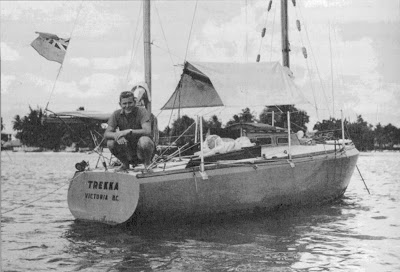
Between 1955 and 1959 John Guzzwell sailed solo around the world in a boat that wasn’t quite 21 feet long.

Trekka6bw

The answer to the question “What size boat do I need to go cruising?” was best summed up, I think by Don Casey and Lew Hackler in their book Sensible Cruising: The Thoreau Approach when they said, “The one you have.”

http://www.amazon.com/Sensible-Cruising-The-Thoreau-Approach/dp/0071580255

I absolutely LOVE this book and the advice in it is gold…

And “cruising” DOESN’T have to entail great ocean crossings. Taking your boat and going to a little cove you’ve never been to before is going cruising.

L. Francis Herreshoff, who knew a thing or three about boats had this to say about cruising . . . “Cruising should be entirely for pleasure, and when it ceases to be so it no longer makes sense. Of course those who want to beat out what little brains they have in a night thrash to windward should have a strong, stiff racing machine, a very expensive contraption, one which sacrifices the best qualities of a cruiser. But the little yacht that can snuggle alongside some river bank for the night and let its crew have their supper in peace while listening to the night calls of the whippoorwill will keep its crew much more contented. They will be particularly happy and contented when the evening rain patters on the deck and the coal-burning stove becomes the center of attraction. Then if you can lie back in a comfortable place to read, or spend the evening in pleasant contemplation of the next day’s run, well, then you can say “This is really cruising.”

And here’s a truism most people aren’t aware of: “Boats are used in inverse proportion to their size!” That is, the smaller the boat and the easier it is to use then the more it WILL BE USED.

So, what got me started on this rant in the first place? Well, I’ve once again been bitten by  the “I need to have a shanty boat bug!” And I’ve been pouring over old articles I’ve saved and scouring the internet for new inspiration. And last night I saw this neat thing. It’s LaMar Alexander’s 8×12 Stealth-boat Tiny House Design.

lamar-alexanders-stealthboat-8x12-tiny-house-design-001

The VERY FIRST THING that crossed my mind was, “with just three more sheets of plywood you could extend it to 8X20 feet and have a lot more room!” I mean that was my instant reaction, and it’s really not wrong, I don’t believe, if you’re making something that you intend to live on.

 http://tinyhousetalk.com/lamar-alexanders-8×12-stealth-boat-tiny-house-design/#m2rqK975Cd4K6q2A.99

An eight by twelve foot shanty like this would be a great weekender or fine for a short vacation, but I really believe if you’re going to spend much time on it you need to make it AT LEAST 16-feet long but I wouldn’t go over 20 because of cost, weight, time to build, etc.

Just be wary of where you brain leads you. It’s going to automatically make you want to go bigger.

1 Comment

Filed under Uncategorized

Trapped

One of the problems with living in a rural are like Boquerón, well, any rural area for that matter, is that if something goes wrong on the main road you travel on there are very few alternative routes open to you.

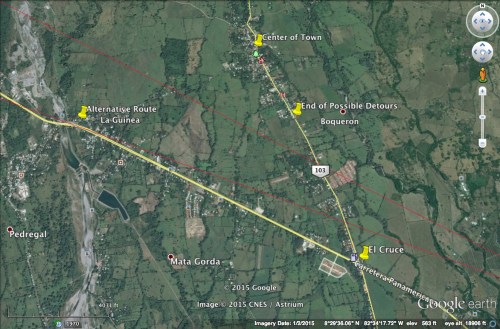
They’ve been working for several months, now, to resurface the main Boquerón road from El Cruce to the town center. And believe me, it needed to be done. They started tearing out the old surface back at the end of August leaving a rutted dirt road in its stead. Then, at the end of September they started laying down the macadam. I was still living at the other house then and they came on down to a couple of blocks below the caseta (bus shelter) where I’d pick up the bus. As you can see from this Google Earth pic, from the town center there are several alternative route that the buses and taxis can take that parallel the main road. Up to a point, that is.

Detours

From that last yellow push pin down to El Cruce is a little more than 2 kilometers. A mile. The entrance to the barriada lies in the middle. Last Wednesday I needed to go over to Bugaba, the next town west of here, to buy some spices I needed for a recipe I wanted to try. I got a cab at the entrance to the barriada which took me down to the crossroads and immediately picked up one of the many buses that pass by all day long. I was at the Romero supermarket about 15 minutes later.

It only took me a couple of minutes to get what I needed with no impulse shopping since I’d done my weekly grocery shopping a couple of days earlier. I was back at the crossroads in less than an hour from when I started. One of the Boquerón buses was there, but I couldn’t get on. The road had been closed for grading. They weren’t letting anything but official traffic through, so the only way to get back home was to WALK! And it was HOT! Took me over a half hour because of my emphysema and stopping every couple of hundred yards to rest in a bit of shade.

Today I needed to make a trip to the grocery store again and stock up for the week. Saturday was the big Independence Day here, and as in the States when a holiday falls on the weekend Monday is usually a day off from work except for places like supermarkets and restaurants. I figured they wouldn’t be working on the road until Tuesday. I was wrong. They were grading and a steam roller was following the grader. It wasn’t looking good though traffic didn’t seem to be affected. Cars, trucks and taxis were passing in both directions past the caseta where I was lolling in the shade.

A young indigenous lad came up and sat down in the caseta with me and he struck up a conversation which was quite unusual. It was the first time in over five years that this has happened to me. He was curious about Florida when I told him that’s where I was from and he actually knew that Miami has a huge Spanish-speaking population. He said he has a friend who lives in Toronto and hardly anyone speaks Spanish there, of course. The first Cruce-bound taxi came around the bend and I was able to flag it down. I needed to get over to Bugaba as fast as possible on the chance that they might close the road to traffic again.

Well, I made it over there, did my shopping and got back in a little more than an hour this time. The road was still open and a north-bound Boquerón showed up less than five minutes after I arrived. I now have groceries enough to take me into next week, but I know that in a couple of days they’re going to start laying the black top and then we’ll all be trapped here since there are no alternative vehicular routes down to El Cruce, or most of the way up toe the center, either. The folks in above us here in the barriada will be able to get a bus which will take an alternative route from the town center down to a place called La Guinea on the Interamericana and from there into David.

Alternative Route

But I don’t care. I’ll just hunker down here.

2 Comments

Filed under Uncategorized

Adapting

Some might say I’m a bit strange, and I won’t argue the point. Some might say I live a minimalist lifestyle and I’m not so sure that’s entirely true but there are hints of it.

Almost all of us gringos grew up with hot water for bathing. Hardly any Panamanians did. In fact, there is a belief among many Panamanians that hot showers and baths are actually bad for one’s health. In fact, I had a neighbor lady tell me just that within the last week!

Over the years I’ve had situations where hot water wasn’t available at the turn of the tap. When I lived on my shanty boat in New Orleans I didn’t have hot water. When I wanted hot water to shave I had to put a pot on the stove and warm the water up. No big deal. I worked at a boat yard and did a lot of paint “prep” which consisted of spending eight hours a day with an electric sander in my hand making dust, much of which covered me by quitting time. Back at the boat I had a shower head rigged to a hose supported on a 2X4. New Orleans has a pretty hot climate most of the year, and the water in PVC piping that serviced my dock was rarely cold. Tepid to warm would be the best words to describe the water temperature so it was pleasant. In the three or four winter months I had a good friend who lived on my route home from the yard and he kindly allowed me to shower at his place. So things worked out pretty well.

The next time my living conditions didn’t have hot water on demand was when I bought my much-missed Nancy Dawson, a Kaiser 26 sailboat. I took off on her for nine months and single-handed to Mexico, Belize and the Rio Dulce in Guatemala It was always hot there so when I was in the salt water areas I’d dive off the side of the boat, climb up in the dinghy and lather up with Joy dishwashing soap (the only thing that produces lather in salt water) and then I’d rinse off with fresh water. That’s necessary because salt from the sea drying on your body will eventually give you a rash. When I returned to the States I lived for close to two years in a boat yard and then at a marina for another four years or so, and each place had shower rooms so hot water was not a problem.

In the first year and a half here in Panama I was house sitting at a place for two six-month stints and they had an on-demand hot water heater. The place here in Boqueron also has an on-demand water heater that doesn’t work simply because most of the time the water pressure isn’t high enough to trigger it. Now, I haven’t gotten used to cold water showers, though I have to say the water is never cold as it is in the States, but it’s still cold enough that I don’t find it comfortable most of the time. The exception is on really hot days in the middle of the afternoon then it feels good to get in the shower.

For shaving I do what I did on the shanty boat. Heat water in a pot and use that. I wash dishes in cold water and since most houses in the country don’t have hot water some brilliant people have created a soap that lathers up in cold water.

So, how do I deal with the cold water showers? Well, one way is what I would call a “modified sponge bath.” That is to say I stay out of the main stream of the water and use a soapy face cloth to wash myself. I don’t mind sticking my head in the cold water to wash my hair, though.

But I DO like warm water to shower with. For quite a while I used a “Sun Shower.” One of those four-gallon plastic bags that you lay in the sun for a couple of hours and it heats up the water.

stearn_sun_shower

Does a damned good job, too. You can scald yourself if you’re not careful. The problems I had with it was hanging it up in the shower compartment space. Fresh water weighs 8 lbs. a gallon, so hoisting the 32-pound bag was a bit of a pain in the ass. Also, since it’s gravity-fed and the shower head nozzle was only about three feet off the deck I had to squat down to get under the water stream. It wasn’t a lot of fun to use, but I did. The biggest problem  was keeping the inside of the bag clean. Green slime would build up and eventually, even bleach wouldn’t get rid of the crud.

The end result for getting a hot water shower comes in the form of this thing.

IMG_0826

It’s designed to spray toxic chemicals on weeds. I’d tried a smaller version years ago on the sailboat. It only held a gallon of water, and the spray nozzle wasn’t worth a damn. I think I tried it two or three times and gave up. But I decided to try again. This one holds 2-1/2 gallons. I did cut the hose and nozzle off of the sun shower and rigged it up to the new setup. A little bit of black spray paint et voilà as we used to say over in Antibes, France.

This certainly does the job though it’s no where near as exhilarating as standing under a REAL hot shower. I set it outside in the sun for a few hours and the water heats up nicely. A few strokes of the pump handle and there’s a decent flow of water. There’s a thing-a-mah-jig by the squeezer on the spray handle that allows for a continuous stream. Since the capacity of the unit is only 2-1/2 gallons you can’t stand under the hot water stream for a long time, but it’s enough to actually provide TWO Navy showers.

A Navy shower is essential for shipboard life where fresh water is limited. What you do is get wet, shut off the water stream, lather up, rinse off. It works. Another feature of the new set up over the Sun Shower is that the neck of the bottle is pretty wide, so if it has been a cloudy day, or I want to take a shower early in the morning all I have to do it put on the big pot of water, heat it up and pour it in to the container with the cooler water and then I’m able to get a comfortable shower.

Like I said, I don’t recommend that people live as I do. Most wouldn’t want to, but I’m adaptable. You have to be, after all, to live for nearly six years on a 26-foot sailboat.

2 Comments

Filed under Uncategorized