Further Adventures In DIY Boat Maintenance

Exactly a month ago I wrote about removing the old, frozen outboard motor bracket from the boat…  https://onemoregoodadventure.com/2019/10/01/the-cruising-life/. As of yesterday the new bracket is now sitting jauntily on the transom. It wasn’t easy!

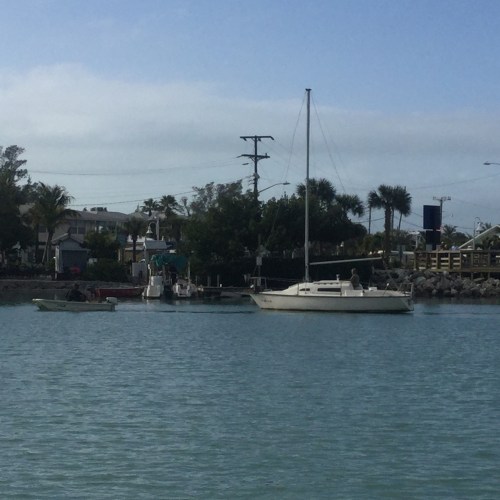
You have to know a bit about me to understand how difficult the job was. I’m 77 years old. I operate on lungs with a bit less than 40% of capacity due to COPD. I have three arterial stents and my fingers are gnarled from arthritis. I live full time on a Venture22 sailboat anchored off of Coquina Beach, Anna Maria Island, Florida, a bit south of Tampa Bay. Most of my adult life I made my living on the water either operating boats or repairing the damned things.

I tried to install it a week or so earlier but couldn’t do it. I I thought if I could get one or two of the 5/16″ bolts through the holes it might hold up well enough until I could climb down under the port seat in the cockpit to get the nuts on. And I’m trying to do this in a dinghy! The damned thing is heavy at 20 lbs and wakes coming in from the nearby Intracoastal Waterway had me bouncing up and down. Kersploosh! One of the bolts drops off into Davy Jones’s locker. Certainly a pain, but from years in the business, even though there are only four holes to be filled I bought FIVE bolts.

This wasn’t going to work so I gave up for the time being. I made a couple of calls to guys I know who are anchored up above but got no reply. So I’m thinking over the next couple of days, “What would I do if I was off on some deserted island by myself? How would I be able to cope and get the job done?

I pondered for a couple of days and then it hit me. I’d been going at it from the wrong direction! If I had a bolt sticking OUT of the transom it should be easier to get one of the holes to slip over IT than to try and get a bolt to slip into what is a small, moving hole. In my container of assorted odds and ends I found a 3” long bolt and nut and a couple of fender washers. The strange thing I notice as I’m digging through the stuff is that I’ve got a good assortment of bolts but, oddly, very few nuts to fit anything.

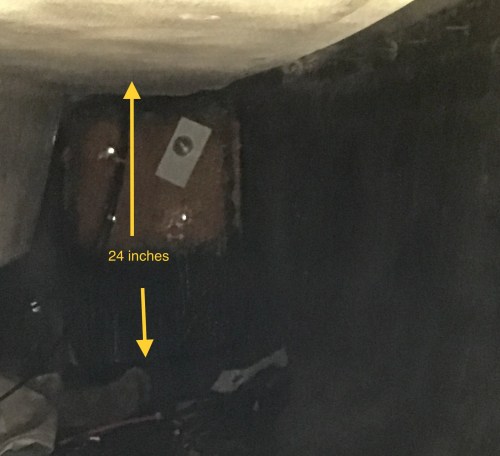
So, I have to climb down under the portside cockpit seat and it’s not easy. For the benefit of those who didn’t read the previous post this is the challenge…

IMG_0116

IMG_0118

Best case scenario is that I’ll only have to do this three times. Did I tell you I still believe in Santa Clause and the Easter Bunny?

I toss the bolt back to the transom and dive into the hole head first and inchworm my way aft. Though it’s a bare 7 feet, a half century of inhaling the smoke of licit and illicit substances has taken its toll and I have to pause a couple of minutes until my breath returns to normal. Or a reasonable facsimile of normal, anyway. Struggle my way out of the hole, into the cabin and up into the cockpit where I have to rest up for a few minutes.

I then wrestled the 20 pound  bracket down into the dinghy and, hand over hand, pulled my way to the stern. I tied the bow and stern of the dinghy off to keep from moving around as much as possible and then tied a length of paracord to the bracket and secured it to the stern railing so that if I lost my grip on the thing it wouldn’t fall into the water.

I lift the bracket up to set it on the protruding bolt and it nearly slides back into the hole. I forgot to secure it with duct tape as I’d planned.

Unfasten the bracket. Back around to the side of the boat and up into the cockpit. Down into the cabin where I rest for a couple of minutes before plunging into the hole again. A couple of pieces of tape over the head of the bolt only take a couple of seconds. That done, it’s inch my way topside again and tie up astern once more. Resecure the bracket to the stern railing and lift the bracket up onto the bolt. Holding it in place with one hand I slide a fender washer over the bolt and finger tighten the nut to hold the bracket steady while I put the bolts into the upper and lower outboard holes of the bracket. The holes aren’t exactly lined up but a couple of light taps with the small hammer I’ve brought along takes care of that, and the bolts are head-deep in the holes.

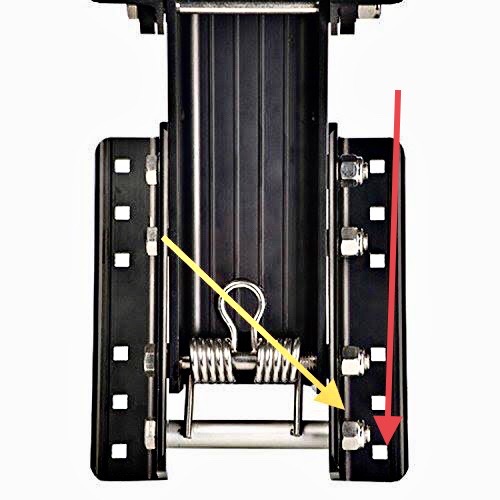
The problem comes with the inboard bottom hole. The way the thing is built the bolt (yellow arrow) protrudes too far to allow the head of the bolt to pass by and enter the pre-drilled hole (red arrow).
IMG_0171

Back into the boat cabin and dig out the cordless drill and a bit that will fit through the hole. I’ll drill all the way through the transom from the outside in the hole just above the intended one. It will be a pilot hole. Then, when I’m inside the hole again, with the proper sized bit, because that one won’t fit through the bracket hole, I’ll enlarge the hole until the bit bottoms out on the metal of the bracket.

Now I’m back in the hole for the THIRD TIME. Tighten the two lock tight bolts after fitting aluminum backing plates over the bolts and enlarge the new hole. I remove the tape from the pilot bolt and use some two-part epoxy stick putty to fill the hole that’s useless.

Outside and tied up to the transom again I remove the pilot bolt and put the new bolts into the holes. Back around to the side of the boat. Up into the cockpit. Down into the cabin. Squeeze into the hole. Inchworm my way to the transom and tighten the two final bolts.

DONE!! It looks cool back there. Today I just gave the go ahead to Cannon Marine down in nearby Longboat Key to order me a Yamaha 6 horsepower, long shaft, four stroke outboard. The price is nearly $300 less than a similar model Mercury outboard from West Marine or Bradenton Beach Marine. Monday I’ll know when it will be delivered. It has to be ordered from Yamaha as it’s not in stock but will be coming in with some other, larger engines they’re going to be ordering. When I get it I plan on doing a bit of cruising around the area. Up into the Manatee that goes through Bradenton and into Sarasota and the Hillsborough River that flows through downtown Tampa. I want to go up there and check out the Jean Street Boat Yard. It’s the only one close by (40 miles away) that will let you work on your boat yourself. I need to paint the bottom to fend off the barnacles and other flora and fauna that grow on it in these warm, shallow waters. An interesting side bar to the Jean Street yard is that it’s the oldest boat yard in the entire state of Florida, opening its doors for business in 1848!!!


Comments Off on Further Adventures In DIY Boat Maintenance

Filed under Boat Repair, boats, cruising, Living on the hook, Minimalist Cruising, Outboard Motors, sailboats, Small boat cruising, Uncategorized

More of the Cruising Life

One nice thing about being retired is that there’s no big rush to get things accomplished ASAP. I’m under no deadlines as far as working on my boat, especially since no one’s paying me to do it.

I’ve needed to scrape the bottom of my dinghy for a while. When was the last time you went out and scraped junk off of the bottom of your car or pickup truck? All last week I watched a piece of seaweed that can best be described as looking like a leaf of very ripe lettuce grow larger and larger. Really nothing I could do about it then. There’s a tiny, postage-stamp bit of beach on the south side of the boat launch ramp, but it’s only usable at low tide, and the tides weren’t synced right last week. But today it was dead low at 0830 so I went in around 10 on a rising tide. There was enough of the “beach” left to put the things I keep in the dinghy, shopping cart, life jacket and throwable flotation required by the USCG, spare paddle, etc. on shore.Flipped it upside down and went to work with the scraper. For most people reading this it wouldn’t have taken you more than about 15 or 20 minutes to get the wildlife (barnacles) and vegetables off the bottom, but I’m working with about 40% lung capacity so several breaks to catch my breath extended the job to about an hour. It’s amazing how much easier it paddles with all that stuff gone.

As I wrote, recently, I need to replace the original outboard motor bracket that came with the boat. The last year with the old Honda 9.9 at more than 100 lbs rocking and rolling in the passing wakes bent the arms of the bracket so I couldn’t raise or lower it. I’d always had a problem with it and had resorted to a block and tackle arrangement to use it. Even then it was extremely difficult.

I described how I got the jackplate (as the brackets are sometimes called) off the transom, elsewhere. Of course the bolt holes of the new bracket aren’t the same as the old one. So last week I bought some epoxy stick. Break a bit off the stick and knead it until the color from the two parts blend into a solid color and then stuffed it into the old holes.

This afternoon I climbed into the dinghy with the bracket to which I’d attached some rope to tie to the stern railing to keep it from taking a swim.

The first hole was easy. I moved the bracket around until it looked good. . .i.e. there was enough room to operated the lift arm properly. . . and made sure it was about an inch away from one of the original holes and went at it with the 11/32 drill bitt. Of course it needs to be a bit bigger than the 5/16″ bolt so it can slide through the hole in the transom easily.

With that hole drilled I slipped one of the 5/16 bolts through to help hold the bracket in place so I could determine where the next three holes needed to be drilled. Using a smaller bitt I drilled into the center of the holes and then removed the bracket completely off the transom. Back to the 11/32 bitt I used the smaller holes as guides and drilled completely through the transom.

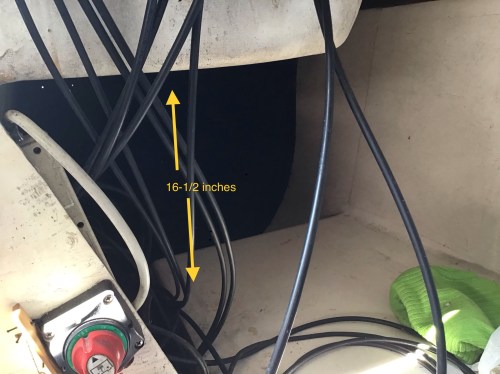
t was the middle of the afternoon when I finished this up and I didn’t feel like moving all the detritus necessary to climb into that 16-1/2″ entrance to where I’ll be accessing the bolts to tighten things up. I’ll get that done sometime in the next few days. No hurry.

Comments Off on More of the Cruising Life

Filed under Boat Repair, boats, Bradenton Beach, FL, cruising, Living off the grid, Living on the hook, Minimalist Cruising, Outboard Motors, Uncategorized

The Cruising Life

Some wag once said, “The cruising life is repairing your boat with inadequate tools in exotic locations.” The fact that I have only “cruised” about a third of a mile in the last six months does NOT negate that statement.

I’ve been struggling to remove the original outboard motor bracket on the port side of the transom. The boat had a 25hp Yamaha when I bought it. Much too big and heavy for such a small, light boat as a Venture 22.  It as a lousy engine, too boot. Broke down THREE TIMES between Ft. Lauderdale and Stuart. First time was in Boca Raton, about 20 miles from the start of my venture. It broke down again another 20 miles or so up in West Palm and finally in Stuart. If you searched for the term “hunk of junk” in the dictionary there’d be a picture of that outboard.

I replaced it with an old model 9.9 Mercury outboard. It took me from Stuart, across the state via the Okeechobee Waterway up to Carabelle in the eastern panhandle, and back down to Bradenton Beach where I live at anchor. Last year it took me from here to Cayo Costa and back, a journey of nearly 200 miles. The engine has worked like a charm for close to 2,000 miles. Its single shortcoming is that it’s a “short shaft” outboard and the prop cavitates when I’m rocked with the wakes of other boats and I really can’t use it when the seas are over 2 feet.

To work properly as auxiliary power for these small sailboats the outboards really need to be “long shaft.” Twenty inches, minimum, from where the engine attaches to the motor bracket to the cavitation plate rather than the 15 inches on the “short shaft” outboards. Five inches doesn’t seem like a lot. In fact, most women would scoff at that, but it makes a huge difference with an outboard motor. 

A little over a year ago I bought a second-hand Honda 9.9 long shaft 4 stroke outboard. I had another bracket, sometimes called a “jack stand” that I attached to the starboard side of the transom, and moved the Mercury to it, and put the Honda on the original bracket. 

I just never got the Honda working right. Problem with the idle speed. Since the Merc worked fine I never did what needed to be done to get the Honda working properly. So it sat on the stand for over a year. The bracket was never very good, either. I had to rig it with a block and tackle so I could raise and lower it when the Merc was on it. Over the year as the sailboat rocked and rolled in the wakes of passing boats and waves from storms the engine swayed back and forth on the stand. Sometimes worryingly so. Nothing I did with ropes got it to stay stationary.

I’ve been thinking about getting a BRAND NEW four stroke, long shaft motor for a long time. Actually since from about the time I bought the boat in the first place. But I needed to get rid of the Honda so I’d have a place to put a new motor. I DON’T want a used one. I want something BRAND NEW! I want something that if it poops I can take it in, after using the Merc to get me to the repair shop, and say, “Fix it! It’s on warranty!!!” 

Well, I sold the Honda a couple of weeks ago for almost as much as I paid for it. Damned thing was HEAVY. When it came off the bracket the rear end of the boat rose  a bit over two inches! I know, because the barnacles grow just at the waterline and there were over two inches of the buggers above the waterline with the engine gone.

Then I found that the bracket was frozen. The arms are slightly bent from the side to side action of the motor riding the waves. It’s impossible to raise or lower it. I bought a big breaker bar to try and get the bolts loosened up but no go. So the thing to do was to remove the bracket from the boat and see if I can straighten it out on shore. Easier said than done…

Heaven only knows how old the bracket is. Could be as old as the boat which was built in 1980! It’s attached to the transom by four bolts. Now, since I’m doing this unassisted, I have to slither through a small opening into the space beneath the cockpit seat to get to where the nuts are.

Once through that the space opens up a bit, but not a whole lot. Not enough to be able to sit up, so everything is done lying on my stomach. Here you can see where three of the bolts have been removed.

I got plenty of practice doing this sort of thing working as a rigger at a boatyard in New Orleans. But I’m 36 years older now, have arthritic hands, and less than 40% of normal lung capacity.

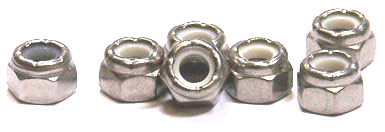
If everything goes well, HA! You work your way aft with your wrenches and take the bolt off. Easy Peasy, no? NO! These are lock-tight nuts. They have a plastic insert in the hole so they can’t vibrate loose.

I get the two lower bolts off easy enough. The top, inside nut is on an extra long bolt and the ratchet socket won’t fit over it. Of course I’m not prepared for this. I don’t have a box wrench or pliers with me . The top outside nut turns the bolt so it’s not coming loose.

Here’s why this is happening. Take a look at this more modern bracket.

See how the holes are square? They take bolts like these…

The square shoulders fit down into the squares on the bracket holes. This makes it easy to then go on the nut side of the bolt and fasten the nut without having someone on the outside holding it with a wrench to keep it from turning like happens with THESE…


Now I have to slither BACKWARDS out into the cabin to work out my next plan of attack. And don’t forget, I have serious COPD problems. I’m operating on about 40% of normal lung capacity so after doing something like getting out of the hole I have to sit for five minutes until my breathing gets back to what passes for normal.

I delve into my tool locker and dig out a pair of Vice Grips and my channel lock pliers. I don’t have a box wrench the proper size.  Over the side, into the dinghy and around to the bracket. I need to attach the Vice Grips to the bolt head. As the bolt is going to turn when I work on the nut, inside, the plier’s handle will also rotate until it comes to rest against one of the arms  keeping the bolt from turning further. OOOOPS. I know from experience that there’s a good chance the pliers might come loose. If that happens they’d fall into the water and be lost. So it’s back around to the side of the boat, up into the cockpit. Rest and catch my breath. Now, where the hell is that ball of twine? I’m not a super organized guy so it takes a while to find it. Back over the side into the dinghy. Around to the bracket. Hold on for a few minutes till my breathing is relaxed again.

After tying the twine to the pliers and securing it to a cleat,  I tighten the pliers onto the bolt head using both hands to lock them on. Back around to the side and up into the cockpit. Sit to catch my breath. Slither into the 16 inch hole and up to the transom. Rest to catch my breath. Use the channel locks to unfasten the nut. When it’s off I take the small hammer and whack away until the bolt end is flush with the transom. That sucker’s really in there. Rest for a few minutes to catch my breath. Agonizingly back out of the pit. Rest. Over the side into the dinghy and back to the bracket. pull the bolt the rest of the way out of the hole and reattach it to the remaining bolt head. Around to the side of the boat. Climb into the cockpit. Rest to catch my breath. Into the hole and work my way to the transom in a motion resembling an inch worm. Rest to catch my breath. Using the channel locks the nut starts working itself off the bolt. CLUNK! The Vice Grips have fallen off the bolt head. SHIT! F WORD! F WORD! F WORD!!!

Out of the hole. Rest. Into the dinghy and back to the bracket. See, I needed that twine. An eighth of a turn on the knob at the base of the pliers and a mighty squeeze with both hands gets them back on the bolt head. Around to the side of the boat, back in the cockpit. Rest. Back into the hole and inch worm my way to the transom. Rest. This time all’s good and the nut’s off. Back out of the hole. Rest. Over the side. Into the dinghy. Back to the bracket. Pull the bolt from the hole. Back to the side of the boat and into the cockpit. Rest. That part of the job is done.

Now I have to pry the bracket off of the transom. It’s stuck on, now, with silicone. Thank heaven it’s not done with 5200 which is the most tenacious adhesive sealant ever created. Silicone has the least adhesive properties of all the sealants, but there’s no telling how much was used when the bracket was attached. In any case, it won’t be easy getting it off. Since the holes on the old bracket are simply round, and not square like the new ones I’m not going to reuse it. I’ll buy a new bracket.

I’ve found a nearby marina down in Longboat Key has four stroke, 6 hp long shafts for sale for $1,650. That’s $200 less than the equivalent Mercury or Suzuki which will cover the cost of a new bracket. And, they’ll bring it up to me. They have to order it first, so it will take a while. Meanwhile I’ll work on removing the old bracket, order and install a new one.

WHEW!


1 Comment

Filed under Boat Repair, cruising, Living Abroad, Living on the hook, Living Small, Minimalist Cruising, Outboard Motors, sailboats, sailing, Small boat cruising, Uncategorized

The Morning Cup

Like gazillions of people I like my caffeine fix first thing in the morning when I wake up. Kick starts the day.

It wasn’t always that way. When I was younger, the only thing I liked about coffee was the way the grounds smelled when you opened the can. The product had no appeal to me. Part of it might have been that my dad was a coffee addict. Drank it all day long at the restaurant at Nauset Beach in Orleans, Mass., out where the forearm of Cape Cod turns northwards in the cold Atlantic Ocean. He took his coffee with cream and sugar but he rarely drank the entire cup and you’d find these disgusting, half-filled cups sitting around, here and there, with cream curdled on the top.

I started drinking coffee when I was in my mid 40s and living over in Antibes, France, (between Cannes and Nice) on the French Riviera. Not surprisingly, the coffee I drank was brewed in a “French Press.”

BrazilFrenchPress_2014_2000x

Whenever I was someplace where they had an espresso machine, though, I’d always get a cup or two of that…my preferred coffee drink.

The last five years living in Fort Lauderdale I had a great countertop espresso maker and used it exclusively though I still kept the French press around.

When I moved to the Republic of Panama I started out as a house sitter in Potrerillos Arriba, in the mountains above the city of David (dah VEED). What a wonderful place that was! I was so fortunate to be able to spend an entire year up there. Actually, the year was divided into two six-month stays, the intervening six months was spent in Boquerón where I would spend the remaining six and a half years before repatriating to the U.S. In the mornings I’d sit out on the front porch with a freshly brewed cup of locally grown coffee (how I miss Panamanian coffee) and gaze down the mountainside all the way to the Pacific Ocean in the distance.When the coffee kicked in I’d move to the back porch under the loom of Volcan Barú where I wrote my book “Adversity’s Wake: The Calamitous Fourth Voyage of Christopher Columbus.” (Available through Amazon)

While up in the mountains I switched from the press to a moka pot…

[The moka pot is a stove-top coffee maker that brews coffee by passing boiling water pressurized by steam through ground coffee. Named after the Yemenite city of Mocha, it was invented by an Italian engineer named Alfonso Bialetti in 1933.[1] Bialetti Industries continues to produce the same model under the name “Moka Express”.]

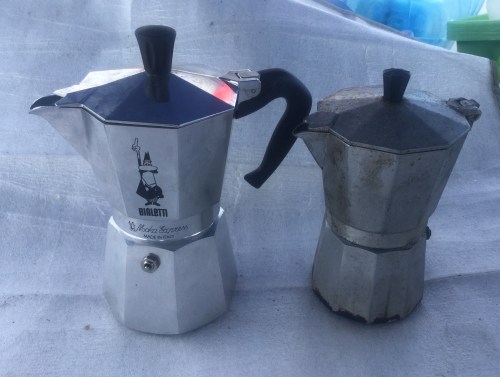
It wasn’t a Bialetti, but rather a cheap knock off that I think cost me under $10. It was a six cup model (that’s espresso-size cups!) and I used it daily until about a week ago when the handle broke off.

803795A5-A0ED-4ACC-9D3E-07CF1210EA63

I made a bus trip out to Bed, Bath, and Beyond and bought a REAL Bialetti six-cup model. As you can see, it’s actually larger than my original pot.

6ADA9759-090B-4655-8744-EB04090D79FF

Now, one of the problems I have with this size pot is that the brew nearly fills an American-sized coffee mug. That wasn’t a problem when I was living in Boquerón because when the coffee would cool down to below tepid I’d just nuke it for 30 seconds and I’d be good to go to the bottom of the cup. Not having a microwave on the boat ended up throwing away close to a half cup every day, and of course wasting the grounds to make the stuff. A moka pot on brews up what it’s designed for and you can’t adjust it.

I went online and ordered a 1-cup Bialetti model. It’s fine for making a thimble-size Café Cubano for an aprés dinner sip, but not nearly enough to get the day started. That, then, led to the purchase of the 3-cup model which is just right. It cuts down on the volume of grounds used, and if needed a second batch can be brewed up in no time.

122EA99C-513F-41D0-B753-AE47848D2390

Life is good anchored out…

Comments Off on The Morning Cup

Filed under Uncategorized

Anchor Anxiety

People who live on land cannot know the anxiety felt by someone who lives their lives on a small boat that’s constantly at anchor when they read a weather forecast like this: ”

A chance of Showers and Thunderstorms early in the Morning, then Showers with a chance of Thunderstorms in the late morning and afternoon. Windy. Some Thunderstorms may be severe. Highs in the mid 80s. Temperature falling into the mid 70s in the afternoon. South Winds 15 to 25 Mph, becoming southwest in the afternoon. Gusts up to 45 Mph. Chance of rain near 100%.” Forty five mph winds are a Force 8 on the Beaufort Scale. . .A “Fresh Gale.” Tropical storm winds are anything over 39 mph.

Sitting in your solid house you wonder why that causes such anxiety? Well, consider this: When you live “On the hook,” your life and everything you own is literally hanging on the end of a hunk of metal dug into the sea bed with a piece of rope connecting it to your boat.

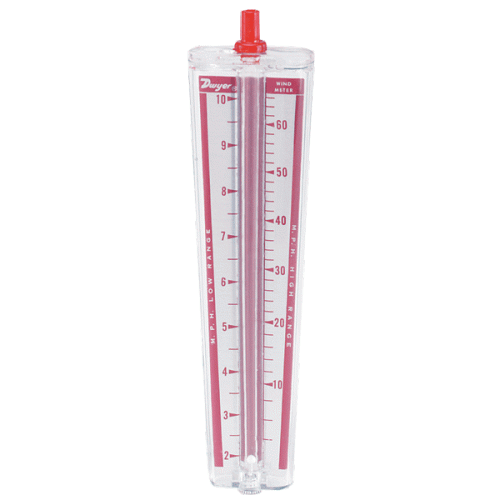
Last week I ordered a wind speed device; the Dwyer Wind Meter.

WINDMETER_600x600

I owned one way back in ’92 when I was on my 9-month, single-handed trip from Fort Lauderdale to Mexico, Belize, and the Rio Dulce in Guatemala and back. It’s the soul of simplicity. The only moving part is a small foam ball. It measures wind speed the same way a pitot tube does.Face directly into the wind with two small holes at the base of the gauge facing the wind and the little ball in the tube rises and you read the wind speed there. There were a lot of other wind speed jobbers on offer but they all have a few problems as far as I’m concerned. One, they need batteries to function. They all have LCD screens which are often hard to read in bright sunlight. The worst feature of all of them is they have little fans that the wind turns (cancer machines, maybe?). Anything that whirls around on an axle is prime fodder for a break down.

The reason I bought it was to see what the wind speed actually is where I am located. The online service uses recordings from the Sarasota Airport which is 10 miles away.

I tracked the order and it said it had arrived at Bradenton, but not at the address yet. My mail drop doesn’t open until 10a.m. so I waited until 10 to leave the boat hoping it would have been delivered by the time I got there. It was windy, around 15 to 20 mph with whitecaps everywhere. Of course I didn’t NEED it, but I WANTED IT!!!

Getting to shore wasn’t a problem. Unfastened the painter and gave the dinghy a shove and the wind blew me right to the dock tout suite.Only had to paddle a few strokes to be in a position to tie off.

Since chances are good that I’ll be boat-bound tomorrow, possibly Saturday, too, I stopped in at Dollar Tree to stock up on junk food.

Back at the dinghy dock I hung around for close to an hour hoping one of the boats that had an outboard would be heading to their boat and give me a tow, but no such luck. According to the new wind gauge it’s blowing mid teens to 20 mph. With my COPD trying to paddle against that breeze would put a severe strain on lungs and heart. But I wanted to got back to my mother ship.

Generally I don’t go ashore when the conditions are like this but I’d thought about using the following procedure, though.

I handed myself down the length of the next two dock south of the dinghy dock to where I was nearly parallel with the Venture. Now it was a matter of paddling ACROSS the wind, not into it as you can see from illustration. The only thing wrong with the illustration is that the heads on arrows for the wind direction should be 180 degrees in the other direction fro what’s shown.

wind

It’s time to cook supper now, and of course the wind has dropped to nearly nothing.

Then, on Friday, this comes through on the internet….”Tornado watch in effect until 4 p.m. as strong cold front approaches. Hail possible and gusts in excess of 45 mph.”

Uncomfortably bouncy here at the Bradenton Beach, FL anchorage this morning. It started getting lumpy around 4 a.m. and I had to get up at 4:30 to see how bad it was. It wasn’t nice.

Though the forecast calls for near 100% chance of rain today it’s bright and sunny. Radar shows heavy bands of rain at the edges of its range heading this way but wont get to us for at least another couple of hours. There’s no telling, yet, how wide the band is, though.

The wind is puffing away. The reports from Sarasota Airport, 10 away, say the wind is blowing at 18 mph with gusts of 29.9 mph. My Dwyer gauge shows 15 mph with a couple of gusts in the mid 20s.

So far it’s no worse than other nastily windy days. I have three anchors over the side and check landmarks on shore from time to time and not dragging an inch.

Then: The worst is over. Though it’s still quite breezy, gusting into the mid 20 mph range, the sun came back out around 5 p.m.

I took down my tarp and lowered the Bimini top around 11 a.m. to reduce “sail area” of the boat due to the high winds as the cold front approached the Bradenton Beach, FL anchorage.

It started raining heavily around 1 p.m. and the temperature dropped noticeably. I was hunkered down, snug as the proverbial bug in a rug while the heavy swells tossed stuff around in the cockpit and cabin.

Slowly, almost reluctantly, the wind edged around from southeast where it came across the 12+ mile fetch across Sarasota Bay to the southwest where it was coming across Anna Maria Island from the Gulf of Mexico. Now, with only a mile and a half of open water between the land and the anchorage the bouncing was almost completely reduced. Now the wind is in the northwest quadrant and there’s just a slight movement of the boat. Put the Bimini back up and got the tarp back in place. All’s right with the world.

Saturday morning and it’s bright sunshine, crisply chilly for a mid-April Bradenton Beach, Florida day. Wind’s still gusting up into the mid 20 mph range but coming from the northwest the wave action is minimal. With food and water on board and the battery bank charging well from the solar panels there’s no urgent need to go ashore today. Tomorrow winds are predicted to be less than half of what they are today and the temperature will be a bit warmer. A good Easter Sunday for those of you who believe in that stuff.


Comments Off on Anchor Anxiety

Filed under boats, Uncategorized

A Mess of Metal

When I was returning to the boat at Bradenton Beach, FL, anchorage after doing some grocery shopping Friday I noticed that the ½” line that leads to 40’ of ¼-inch chain that’s fastened to my 22-lb Manson Boss anchor was hanging oddly in the water. When I pulled on it I found, to my horror, that it was no longer attached to the chain. Somehow the shackle had become unhitched despite having the pin secured with a heavy plastic wire tie.

It was late in the day so I couldn’t go searching for the lost anchor and chain. The ⅜” line was still pulling well on the 30 feet of chain that links it to the 13-lb Danforth so I figured it was holding me well. I attached the bitter end of the ½” line to the 25-lb Danforth that was on deck and tossed it over the side as an extra precaution.

Saturday morning broke bright and nearly windless and the tide was almost dead low. The water was crystal clear and the bottom only about four feet below me. I hopped into the dinghy and went searching.

The last time I’d seen the anchors, a couple of months ago, they seemed to be fairly close together. I figured the best bet would be to run down the ⅜” line and search out from that point. I was surprised to find both anchors together and amidst a big ball of chain. I was JUST able to hook the mess with my boat hook but I couldn’t raise it to the surface in my tipy little cockleshell, and since the tide was rising I abandoned the effort for the moment. With light winds in the forecast and the Manson Boss seemingly well dug in I felt fairly confident nothing disastrous would happen. Realistically I was fastened to 35-lbs of anchors and 45-lbs worth of chain. In effect an 80-lb anchor.

My guess is that over the past couple of months with tidal currents pushing the mother ship back and forth  four times a day coupled with the rough, blustery winds we’ve been having out of the southeast and northeast the lines got pulled this way and that until everything got all messed up.

It occured to me as I was having supper that I could probably lift the metal mess from the bow of the mother ship, a more stable platform than the dinghy.

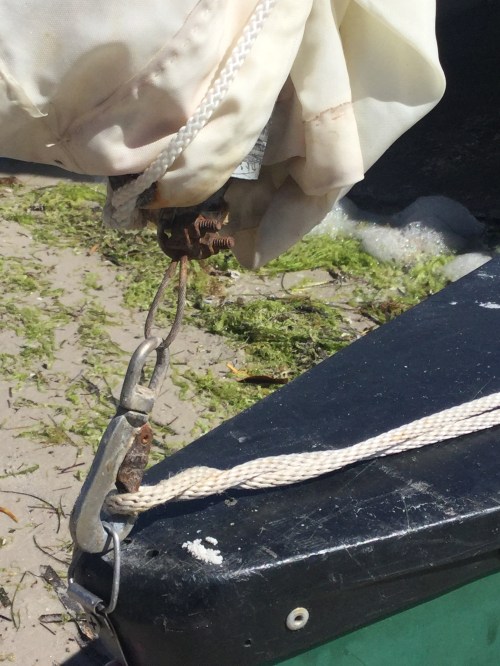
First thing Sunday morning, after my mug of espresso, of course, I hauled the iron mess up out of the water. It took several tries to break it free of the sandy bottom and I had to rest several times and suck on my inhaler. Fifty years of smoking licit and illicit substances was NOT a good idea. You can see from the photo what I was facing. I wasn’t able to get it out further than this, though.

I untangled a lot of it, but not all. I’m going to need the assistance of my friend, Todd to get it all done. His dinghy is much more stable than mine and we can haul it out. Plus, he’s much younger and stronger than I am. Since it is essentially one solid mass of metal right now I got it positioned so the Manson Boss is set in the sand and I’m good for the moment. We’ll go at it tomorrow. Sunday isn’t good because every jerk that owns a boat in Manatee and Sarasota Counties is out on the water on this beautiful day and the wakes would make the work nearly impossible. But it’s coming along.

E8D2A6F1-9A0E-431A-9138-B2DDE24FD5F3

Comments Off on A Mess of Metal

Filed under boats, Bradenton Beach, FL, Uncategorized

Where There’s A Will, There’s A Way

It will be no surprise to anyone when I say I LOVE weird boats and the people who construct them. So Imagine how much I enjoyed seeing this boat drift into the Bradenton Beach, FL, anchorage this morning and beach out in front of the Bridge Tender Waterfront Bar.

tri 2

The owner’s name is Dean and he likes traveling around and poking into out of the way places with his canoe. But, he said, it was too unstable to allow him to go certain places. So, he took a Standup Paddleboard and but it in half along the centerline. Topped it off with some light plywood. The amas are held in place with construction extrusions and everything is put together with hurricane clips and wing nuts so it can be easily assembled and disassembled.The mast sail comes from a small day sailer. The jib is an old shower curtain and is self furling with a snap shackle fitting.

swivel

The lee boards were made from pine that he bought at Home Depot and glassed over. EVERYTHING was either scrounged, donated or came from a big box hardware store. He has a sleeping bag and a tarp to hide under when it rains. He spent the previous night anchored down in Sarasota Bay somewhere and was heading back there soon after we finished out conversation.

Never forget, whether you’re Dean on your cobbled together trimaran or a multi million dollar yacht the sunset’s exactly the same…

Oh, and as far as I’m concerned the crowning touch is the little mermaid figurehead!

figurehead

Comments Off on Where There’s A Will, There’s A Way

Filed under boats, Bradenton Beach, FL, homemade boats, Microcruising, Minimalist Cruising, sailboats, sailing, Small boat cruising, Small Sailboats, Uncategorized

Dinghy Repairs

When I bought my boat nearly two years ago and took off on my ill-fated journey that ended up at Tallahassee Memorial Hospital I had no dinghy.A dinghy didn’t become essential until I got to Bradenton Beach, FL, anchorage. Then I bought a cockleshell piece of junk for $150. It’s ugly as sin, needs to have gunwales installed and a bunch of other things, but all in all it has served me well.

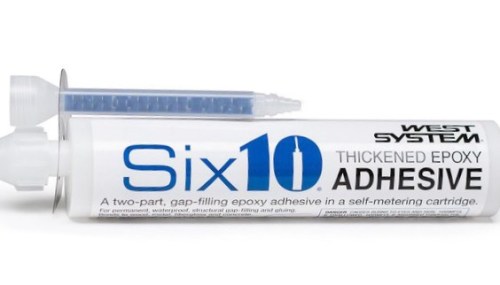
One of the problems the dinghy had was what serves as a seat in the bow was separating from the hull on the port side. It has bugged me for ages but I just let it go. A month or so ago when I went out to buy some new shoes I found myself not too far from West Marine so I went there and bought some Six10 thickened epoxy adhesive.

I’m a big fan of thickened epoxy. When my friend Stephen and I had a marine repair business in Fort Lauderdale decades ago we used a LOT of the stuff in rebuilding things like sport fishing boat cockpit decks. Stef had the West System Epoxy pump system that automatically mixed the proper 5:1 blend with the push of a lever. Add colloidal silica or micro fibers and go to town with the stuff. But buying the individual chemicals and glop to do a small job was not worth spending the money…epoxy, hardener, thickener. I’d seen the Six10 in the West online catalog and it was an all-in-one tube you use with a caulking gun. I sprung for the $26 and bought some and an extra couple of nozzles because the job of repairing the dinghy wasn’t going to use all of it.

Those nozzles are pretty ingenious. As you look at one it has lots of little chambers along the way. The tube is divided into two parts: epoxy and hardener. They get mixed as the goo is squeezed out of the tube. The chambers (19 of them) shift the resin and the hardener from one side to the other to combine the two.

As you can see it’s a pretty big gap that needs to be filled. A quarter of an inch, at least. Because of the location how do I get the seat and the side of the boat to hold together close enough while the epoxy is hardening…Five hours according to the instructions on the tube? Obviously I don’t have clamps big enough to do the job.

The solution was pretty easy. I had a bunch of #8 machine screws, nuts, and flat washers. I drilled through the seat flange and the hull and then stuck the bolt through.Squirted the epoxy down into the gap and tightened the nut and bolt until the epoxy started to be squeezed out. Tightened JUST ENOUGH for the stuff to be compressed and stopped. There’s still a good-size gap, but the integrity of the hull will be strengthened when the epoxy “kicks off.”

One of the biggest errors amateurs make when using caulking or, in this case gap-filling, is that people put a nice, thick layer of caulking around something and then they tighten the screws, or bolts, down till they’re completely tightened thus squeezing 99.8% of the caulk out and leaving a paper thin layer of goop. Then they wonder why it still leaks. You need to put that caulk down and tighten it up JUST ENOUGH to have the caulking ooze out around the lip of whatever’s being bedded and then STOP!!! Let is sit for a couple or three days until it’s cured THEN go back and tighten the screws or bolts as tight as they’ll go. You’ve created a gasket now and it WON’T leak.

gap

bolts

epoxy

Comments Off on Dinghy Repairs

Filed under Boat Repair, boats, Uncategorized

Final Anchorage

Sooner or later it happens to us all. We DIE! No escape. No bargaining. Kaput. It’s over.

Then what happens?

I’m not going to get into a philosophical discussion about heaven and hell or gods which, for the record, I believe are all male bovine excrement. NO, I mean what happens after your carcass is cold and immobile…??

Burial never appealed to me. It’s creepy when you consider cemeteries: all those people in boxes, six feet under, the dirt, all facing towards the rising sun. Nah, never wanted that.

When my mom died she did something that blew me away. My brothers Jimmy and Howard, both dying in infancy from viral pneumonia, were buried in my dad’s family plot in Woburn, Massachusetts. Mom’s family were planted in Westminster, Mass. She had herself cremated and part of her was laid to rest with the boys in Woburn and the rest in Westminster. How cool was that??? She was also ahead of her time. When Jimmy died, around 1945, despite her grief, she thought of others and donated his corneas so someone else might see! Because of this I’ve had “Organ Donor” on my driver’s licenses, both here in the states and in the Republic of Panama for years.

My dad was also cremated. Some of the ashes were scattered off the Venice, Florida, Inlet. He and mom lived there for years and she LOVED to fish, so the inlet had special meaning. Most of his ashes were interred in Woburn with his family. My brothers, David, Mark, Jeff, and I were each given small Ziplock͢™ bag with some of his ashes. We drove out to Westminster and scattered them on our mother’s grave so they were together again.

I’ve always wanted to be cremated and have my ashes scattered in the Gulf Stream off of Fort Lauderdale, FL. Symbolic in a way. I spent about 36 years of my life, off and on, in Lauderdale. I could envision my ashes drifting up the eastern seaboard that I’d traversed many times in a boat. Perhaps some tiny molecule would make it all the way over to England from whence both of my ancestral families came back in the 1630s.

I’ve read stories about people having their ashes put in bottles and thrown in the sea and the people who find them years later and miles away. Always thought that would be a cool way to go.

I even have a playlist of songs I want played as my ashes are scattered and Amazing Grace ISN’T one of them. No, I’d like:

https://youtu.be/BFTMWYna7kk

https://youtu.be/YwLgxyVjwk4

https://youtu.be/7eL1PS7AXBg

I’m makin’ you click on ‘em to find out what the messages are…and they ARE messages.

Planning for the future has never been one of my strong points. That’s why I’ve ended up living on a small sailboat at anchor and depending totally on Social Security to survive. Like most people, I suppose, I never spent much time thinking about what would happen when my cold, lifeless corpse was discovered. I’d become someone else’s problem. After all, I’D be dead, and the dead don’t seem to care much about anything.

I’ve known about the Neptune Society for years. They do cremations and ocean scattering. But while they’re less expensive than regular funerals they still cost a couple of grand. I don’t have that much set aside and it’s not right to lay that tab on my brothers.

Is there an answer? Well, yes. A little while back I came across a link to Medcure.org. It’s a “whole body” donation program in which you donate your remains to medical science. ALL expenses are taken care of including cremation and, as they mention on their site, scattering ashes at sea.

Perfect. I’ve signed up.


1 Comment

Filed under Uncategorized

Bad Weather Blues

Had to hold off writing and posting this while there was a break between storms. Yesterday was easily the WORST DAY I’ve been through here at the Bradenton Beach, FL, anchorage.

If you’re tired of reading about my complaints on the nasty southeast winds take a guess how I feel having to go through them.

They’ve been blowing hard the last couple of days and I avoided going ashore because of the “Couldn’t make it back to the boat” syndrome. But with fresh food in the cooler and no ice I needed to do a shore run. There seemed to be a bit of a break in the weather and I made a sprint to the dinghy dock. By the time I got back, and it’s only about a five block round trip, the winds were back up in the 20 mph range. My dinghy is a cockleshell and trying to paddle against it is nearly impossible at times. Yes, I’d like to have a small outboard but 1) they cost money I don’t have, 2) If you have any kind of motor on your boat you have to register the vessel. 3) I don’t have a title for the dinghy so there’d be an added level of bureaucratic bullshit. 4) Oars would be better but it was a choice between a $22 kayak paddle and $120 for a set of oars, oarlocks and the lumber and time needed to attach a gunwale and all. So I stick with the paddles.  Fortunately when I got back with my bag of ice and four gallons of purloined drinking water one of the charter boat captains was just discharging his passengers and volunteered to tow me out to my boat. I didn’t hesitate to agree to the help.

Things continued to deteriorate hourly after that.

Shortly after sunset, 7 p.m., the large Danforth secured on deck started moving around and rasping over the non-skid decking forward. Brrrrrrrddddgg! Brrrrrrrddddgg! Brrrrrrrddddgg! There was no way I was going to be able to fall asleep with that going on. I slid the hatch back and stuck my head outside. The waves were well over three feet high and the wind was screaming. The boat seemed out of control, but the anchors were holding and other than rising and falling I wasn’t dragging. Discretion being the better part of valor I decided that the anchor wasn’t doing any more than frazzling my nerves and it wasn’t worth risking my life by going out on deck to do anything with it. The last time I was confronted with a similar situation I attached the bitter end of my ½-inch line to the anchor and tossed it overboard to be retrieved later. It was too late now to do the same thing, though.

Hour after hour the wind howled and gusts rattle my little boat. I fully expected the mast gallows to collapse. I went to bed fully clothed in case I had to get up and go outside and do something to rescue myself. I finally fell asleep.

Around 3 a.m. the rain started pelting the deck. It put me back to sleep. I love that sound. It was still raining when I got up for good around 7 a.m. The wind had done nearly a 180 and was coming out of the northwest and had died to practically nothing.

When the rain had slacked off to a drizzle I stuck my head outside. Nearby was the large charter catamaran that’s been tied to the dock near shore since I arrived here a year and a half ago was no anchored just a few yards away. Strange, it hadn’t been there when I went to bed. And where was “Grace,” the little 22-footer that was usually there? Huh! Perhaps hiding on the other side of the cat though I couldn’t see “Grace’s” mast.

I checked one of the two weather sites I read and found that the wind had been gusting to MORE THAN 45 mph during the night!

Since I was down to only half a tab of my blood pressure medicine and with the wind down and the rain not threatening I decided to make a run to the pharmacy while I had the chance. Before I left, though, I went forward and hooked the Danforth to the bitter end of the ½-inch line again. As I looked up I saw, over on the rocks of the Bradenton Beach fishing pier parking lot, “Grace.” She’d lost her anchor in the night and the winds and waves pushed her ashore and onto the rocks. I’d damned near come to that fate a year ago. I was dragging anchor and fetched up about 60 feet from the rocks when my “desperation” anchor bit and took hold. That was the day before I bought the Boss anchor and the 70 feet of chain.

wreckIt’s four p.m. The sky’s gloomy with rain clouds though the weather radar on line doesn’t show any rainfall in the area. And when I looked towards the pier I saw that with the high tide they got “Grace” floating again. Apparently she hadn’t been holed. Tod, one of the genuine characters here in the anchorage had a line over to “Grace’s” bow and was towing her to a new spot to anchor. Hopefully they won’t go through that exercise more than once.
afloat


1 Comment

Filed under Uncategorized