It’s the rainy season here in Panama. In fact it’s been raining for the past couple of hours and the little indigenous kids who live up the hill aways from me are walking past the house from the elementary school down the hill from me. They rarely have umbrellas. They just slosh through the water either carrying their shoes of the shoes are tucked away in their ubiquitous back packs. The rain doesn’t seem to bother them. It’s part of life here on the isthmus.
Few places outside of Amazonia get more rainfall than here in Panama’s Chiriquí Province. An average year in the provincial capitol of David (dah-VEED) will see 103.158 inches of the stuff fall. And David ISN’T the rainiest part of the province, either. Being mountainous there are dozens of microclimates and some areas have more rain than others.
Several years ago we had a devastating afternoon rainstorm that had the rivers rise so rapidly and so violently that they took out several bridges including one on the main national highway, the Inter Americana between David and Bugaba. At that time I wrote an article in my blog about how much rain that REALLY is. I can’t find it now and after a cursory look decided not to spend any more time on a search.
When meteorologists talk about “an inch of rain” what they mean is that an acre of land would be covered by one inch of rain. Got that?
Well, in the recent flooding in Louisiana parts of the state got over 24-inches of rain and there were spots that got over 30-inches. And they got it between the 8th of August and the 14th.
So how much water is that? Well some geniuses at CNN meteorologist Ryan Maue Louisiana got drenched with about 6.9 TRILLION GALLONS of !!!
To put it another way, that much rain would fill more than 10.4 million Olympic-size swimming pools.!
My friend, Kris Cunningham, had a post this morning about skunks and bicyclists. She rides her bike all over the place, and her most epic journey was from here in Algarobbos, Chiriquí, to Ometepe Island in Nicaragua! She didn’t encounter any skunks along the route. But my mom did, once…
Where I grew up on Cape Cod, Orleans, we had plenty of skunks. They used to get under people’s houses, and if you don’t know this, when they mate they also spray, and while not sprayed directly on you the odor would seep into your clothes and you’d go to school smelling like skunk. But nobody every did anything other than sympathize with you because everyone knew it was only a matter of time before they’d be reeking, too.
It must have been 1959 when this happened. I remember that we owned a 1957, blue and white Plymouth station wagon at the time. My mom was driving home one night from her monthly Eastern Star meeting. She was a Past Matron and a state officer. At the intersection of West Road and Skaket Road she met a skunk crossing the road. (Why did the skunk cross the road? Who knows?) Instead of running the damned thing over she came to a screeching halt inches from the probably petrified critter which promptly turned around, mooned the car and let loose a blast of its juice right straight into the hot radiator.
Supposedly if you’ve been sprayed by a skunk you can decontaminate yourself by washing with tomato juice. While that may work on humans or pets, it’s NOT going to get into all those little spaces of a car’s radiator. The smell lingered for a couple of months.
It wasn’t noticeable after a couple of days when the car was sitting idle in the driveway, but as the radiator warmed up with use the smell wafted through the air. When my mom would be coming down to what we called “The Stand,” our restaurant on the beach on the opposite side of town from our house, when she’d be coming into the beach parking lot down by the toll booth you’d always hear one of the counter girls say, “Here comes Mrs. Philbrick.” You could smell the car a hundred yards away.
It’s been almost three weeks since my birthday and I finally bought myself a present. Probably shouldn’t have because my pocketbook took a huge hit this month. Eight hundred for the new set of choppers. Three hundred twenty five for three months of the faux insurance at Hospital Chiriquí (but it’s better than having nothing). And, of course getting out the rent money. But today I broke down and did it anyway.
So, what did I get? Well, let me build up to it….
Music runs deep in my family. All the way back into my grandparents. This is a photo from those days at what was known as “The Music House.”
That’s my paternal grandfather on the cello. In the back is William Dean on the flute. My mom also played cello when she was in school and her brother, Howard, played clarinet. He was good enough to play in bands that spent the summer on ocean liners plying the Atlantic between the U.S. and England.
My brother, David, is the flautist in the family. It was always embarrassing growing up to have to do the annual music teacher’s recital. David is seven years younger than me but was always light years ahead on the flute. All of us kids had to take music lessons. David, Jeff and I took the flute and Gary and Mark played clarinet. Jeff also became a very good self-taught guitar and banjo player. Jeff’s wife, Jan, taught piano for years and years on Cape Cod and then in Chapel Hill, NC. Their son, Tom, from what I’ve been told is kind of a musical prodigy can pick up and play just about any instrument he can lay his hands on. Their daughter, Kelsey is a violin instructor at Appalachian State University – Community Music School, and a violinist at Western Piedmont Symphony.
Brothers David and Gary BOTH played in the Chatham (Cape Cod) Town Band which is quite an honor because many of the members of that band back then also played with the Boston Pops!!! (Pretty good musical company to keep, don’t ya think?) David, though, became a professional jazz musician.
And then, there’s ME! I played flute and piccolo in the Orleans/Nauset Regional High School Band as well as the Orleans Town Band. (That was no where near as prestigious as the Chatham Band by a long shot, but it got me out of the house once a week for rehearsals.
I stopped playing when I went away to college though and only took it up again a couple of years later when I joined the Navy. I signed up with an old school buddy, John Hinckley (NO, NOT THAT ONE!!). The first full day we were in boot camp and waiting to get our shots a first-class petty officer, a machinist’s mate oddly enough, came in and said he was looking for volunteers for the boot camp band, drum and bugle corps and chorus. John had been an excellent sax player and suggested we volunteer. I said I hadn’t played in over two years. “Well, you might get out of some of the awful stuff ahead for a while if you sign on. And band members DID get out of a lot of stuff, mainly physical training.
So, I did. The first four weeks of what was then a 16-week training regimen was exactly like everyone else’s at Great Lakes Naval Training Center. Then we were marched down to a huge Quonset hut drill hall for try outs. This was it! I knew I was screwed and unimaginable quantities of shit were about to be dumped on my head.
I sat, waiting for my turn. Doomed! I’d never been great at sight reading music and they were auditioning with marches used when Hannibal marched his legion of elephants over the Alps. Doubly doomed!! Finally my turn came around. The petty officer said, “What do YOU play?”
“Flute and piccolo, sir,” I replied.
“Good! If you can hold it right you’re in. Stand over there…”
“What?” I said, incredulously.
“Stand over THERE!”
I was in without even having to play a note. It seems that everyone who played flute was either graduating from boot camp or would be graduating in a couple of weeks and I was the first person to say the magic words: “Flute and piccolo.”
As the newbies our first week in the band company was spent not playing music, but in keeping the drill hall spic and span. Then we were marched to the dentists. I had a couple of wisdom teeth pulled and a drain put in. It got infected. The left side of my face looked like I had partially swallowed a softball. It was that big. Obviously I can’t play. So I’m put in charge of the newest bunch of musicians and directing them in the cleanup operations. I’m not ashamed to say I milked that disability for all it was worth. And as the weeks passed several guys came in who played flute and piccolo and were destined to go to the Navy’s music school after boot camp so I had them sit in for me.
While everyone else was cleaning stuff or practicing I studied our handbook The Bluejacket Manual. I learned that sucker from cover to cover and actually ended up being the academic standout in the entire brigade for my graduating week and got a letter of commendation handed to me by the Admiral in charge of the entire training center at the graduation ceremony. BUT, a week before that happened, the petty officer came over to me and said, “You know, you graduate next week and you have to march in the ceremony.”
Gulp!
Well, it wasn’t so bad. I grabbed one of the flutes, positioned myself with other flautists on either side of me and marched around and moved my fingers like I was actually playing. And that was my Naval musical experience.
My first college roommate was an excellent classical guitar player and I was in awe of his talent. When I was attending (but doing little actual studying) at the University of Miami I bought a guitar and learned to play it. Sort of. I did okay as a rhythm guitarist and loved the blues but my singing elevates Bob Dylan to something like Pavarotti status in comparison. But I had fun with it for a couple of years when I went back to college in the mid 60s but haven’t touched a guitar since. I did try learning piano, though, and had an electric keyboard on the boat over in France. Learned how to do a walking bass with my left hand but never got too good at it.
SO, that brings us up to now…
As I’ve said in previous posts, I’m going to be repatriating to the U.S. (though I may be back in Panama if Donald Chump gets elected. I WON’T live there with him as president. I’d rather die destitute at Regional Hospital in David (dah VEED) Panama. Well, since I’m going to be on the move most of the time on the boat I intend to live on, and only have sporadic internet access, I’ve been wondering what to do to pass the time when I’m at anchor somewhere.
I thought I’d like to take up the guitar again but the things are rather large, you know, and would take up quite a bit of space on a boat only 23 or 25 feet long. I started thinking about a ukelele. Small, fun, musical. And then I went to the biggest music store in David this morning and bought one of these:
There were several different models, and the Yamaha was the most expensive. I bought it because it’s a known name. Now I’ve got something to while away the hours….
There are some people who don’t quite understand why I’m getting ready to leave Panama, a country and its people what I truly love, and repatriate to the United States. I’ve stated that I have developed health issues, severe COPD, and Medicare doesn’t cover you once you step foot outside the borders of the U.S.
Health care here is, generally, excellent. IF you can pay for it up front. But just try getting health insurance if you’re a 74-year-old man with COPD and three arterial stents. Ain’t happening. I have been enrolled in Hospital Chiriqui’s “Insurance” program which really isn’t insurance at all. It is, rather, a program that will reimburse you for up to 75% of covered costs up to something like $30K. The alternative, if you can’t cough up $3 or $4K to get into Hospital Chiriqui or Mae Lewis, is to go to Regional.
Don Ray Williams, who writes a blog called “Chiriqui Chatter” which I have followed for years, is the U.S. Embassy Warden for this area. He acts as a liaison and first contact between U.S. expats and the Embassy. Today he had a great post that goes a long way to explain what I’d be facing if something horrible happened to me requiring hospitalization here…
“I had one person that was in the hospital because he was hit by a car crossing a street in David. The social worker called me one morning asking if I could come to the hospital and tell the patient that he needed to leave because the hospital needed the bed.
“I went to the hospital and the patient could barely talk. He was still in pain. I had the Embassy talk to the social worker and she was asked what their plan was. The social worker told the Embassy that if he didn’t leave, they might be forced to put him by the side of the road. The Embassy staff person asked if that was the same thing that would happen to a Panamanian. I didn’t hear the answer.
“I left thinking he was going to be transferred to Mae Lewis, a private hospital. He had the funds to pay for private care, but was taken to the Regional, because most accidents are taken there. I got a call at 6PM by his landlord saying he had been brought home and he couldn’t talk. Lilliam and I went to his house and called 911. He died while the 911 attendants were trying to stabilize him to return to the hospital.
“In my mind, he died because of the doctor that instructed the social worker to have him released and the social worker following her instructions. I am confident he would not have died in Mae Lewis.
“There were two more patients I met in the Regional Hospital who had been transferred from Hospital Chiriquí after they had run up bills of $40,000 and had run out of funds. Both died after a couple weeks stay in the Regional Hospital.
Another person I met had been transferred from the Interior of Panama to the Regional Hospital after falling. He didn’t have insurance and this was the only trauma hospital that could take him, even though it would have been closer to Panama City’s Santo Tomás. He also didn’t leave the hospital alive.
“I believe the Regional Hospital does the best they can with what they have and there is a tremendous amount of construction going on at the Regional Hospital to serve more people. There are a lot of good people working there, but the staff is stretched to its limit, from what I have seen. I will still say that I would want to go to a private hospital as my first choice.
“I feel fairly confident that Marion, my friend that was shot and left for dead in Potrerillos, would not have survived had she not been fortunate enough to be admitted into Mae Lewis.
“On another occasion, there was a U.S. citizen that was in need of surgery and his son came to Panama to see him. The Embassy asked if I could assist, as the son did not speak Spanish. After being here a few days the son needed to return to the U.S. and I took him to the hospital to say goodbye.
“When we got to the hospital, I was told he could not be seen. I said it was important for the son to talk to him because he was returning to the U.S. and it might be his last time t see him.
“The nurses started making calls, because they are usually helpful when I hand the, my Embassy introduction letter. They finally came out and gave the son and me masks, gowns and gloves to put on.
“We visited the father and after I left, I learned that the ward had a bacterial resistant virus and it was not safe to be there. Sometimes my not willing to take “no” for an answer puts me in places I shouldn’t be. It was good that he got to see his father because he only lived a few days after having surgery.
“Because of volunteering for the Embassy, I have had the occasion to meet a doctor in one of the local clinics that always complains about freeloading and indigent U.S. Citizens that expect free healthcare from Panama. He always says he can’t understand why the Panama government allows these type of people to come here. He always says this in Spanish assuming I don’t understand.
“Now this is not a criticism of the healthcare system, but it is a criticism of this particular doctor. In both cases he implied that he would treat the patient if they made an appointment at Hospital Chiriquí (I assume this is preferable because he wanted more pay).
“Still, I agree with him in that no U.S. citizen should plan on coming here and taking advantage of a public healthcare that is intended for caring for the people of Panama. None the less, his attitude was not one of a doctor I would want in control of my life.”
So there it is. The possibility scares me, especially when I realize that I felt fine right up to the instant I started having my heart attack several years ago. Or when I was walking down the sidewalk outside of Bethesda Naval Hospital and a car got forced off the road and hit me while it was doing almost 30 mph. SHIT HAPPENS. I JUST HATE IT WHEN IT HAPPENS TO ME!!!
The other day I wrote about building a Turtle Dog Hammock Stand because my air bed keeps leaking, and I promised to report on how it all worked out my first night of sleeping in it.
Well, I misread the instructions of a post I thought was the best, but it didn’t work out at all. I tried it out in the afternoon and it held up, but when I got in it that night it collapsed. Fortunately none of the parts landed on me. Since it was around midnight I simply picked up my pillow, went into the bedroom (the stand is out in the huge living room), pumped up the bed and slept there.
Yesterday, Monday, I looked at more photos from different sites, figured out what I’d done wrong, dismantled what I’d done, lowered the hinges and refastened everything. Now the stand is solid and doesn’t move around when I get in the hammock.
So, how did it work out? Mixed review. I normally sleep either on my stomach or on my left side. You can’t sleep on your stomach in a Yucatan-style hammock. Doesn’t work. It’s not real easy to even sleep on your side in it. But I finally got settled in but it took a long time to finally actually fall asleep. The strings aren’t very comfortable on bare skin. But when I did finally drop off things went fairly well. Naturally, being an old fart I had to get up sometime in the middle of the night, and when I’d finished that chore it took a little bit of time to get readjusted to the hammock but I fell asleep faster than the initial attempt.
The positive side is, while I usually am wide awake around 5 a.m., which is the normal get up time for Panamanians it seems, this morning I didn’t wake up until 7:15. Don’t know if that will continue. I didn’t seem to shift around in my sleep like I normally seem to do in a regular bed. Perhaps it’s because sleeping in a hammock you’re not lying on something non-yielding so you need to move around to free yourself up.
That was only the first night. We’ll see how things go. One of the reasons I’m trying to do this is I don’t want to spend the money on a new mattress. I want to save that money for things I will need on whatever boat I’ll be moving on to when I return to the States.
One of the things I brought with me from Fort Lauderdale when I moved to Panama was myYucatan hammock. Hammocks are everywhere here in Panama. There’s hardly a house or a yard that doesn’t have at least one. Nearly every store down at the bus terminal in David (dah VEED) has hammocks for sale. They are not the net style like the hammocks of the Yucatan but are a solid piece of heavy fabric instead. While I see hammocks everywhere here I don’t know if people actually use them to sleep in instead of on a mattress. When I was walking around Isla Mujeres years ago and peeking into people’s houses through their open front doors I saw quite a few hammocks strung between walls and it was obvious that people, mainly Mayans, used them as their beds. I’m pretty sure the indigenous Ngäbe-Buglé, Panama’s largest indigenous tribe and who live primarily here in Chiriquí and Bocas del Toro provinces, don’t sleep in them. I constantly see them loading really cheap foam mattresses onto buses at the terminal.
The wonderful house I house-sat in Potrerillos Arriba when I first came to Panama had widely spaced columns supporting the overhanging roof and they were perfectly spaced for hammocks. In fact, they had three or four of them; the fabric kind that are sold around here. They were okay but not nearly as comfortable as my Yucatan so I swapped out one of theirs for mine for the two six-month stints I lived there.
Since then I haven’t lived anywhere where I could sling my hammock, and I didn’t want to go drilling holes into somebody else’s concrete walls to install hooks to hang it. I had seen some free-standing hammock stands at a couple of stores in David, but, as is normally the case here, when I went to buy one they were all gone and nobody knew if they were ever going to get any more. So I went online to see if there were any plans for building a stand of my own. Silly me, of course there were.
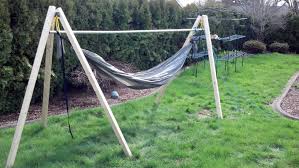
I could buy some 2X4s and build something like this:
Or get a little fancier and build one like this:
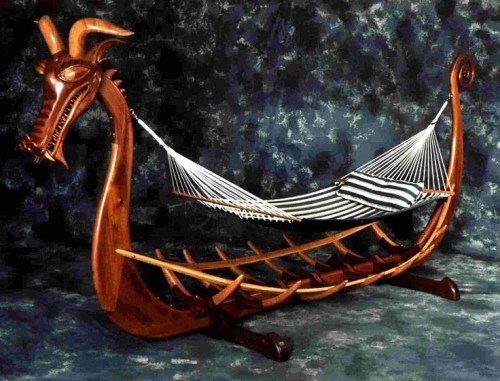
If I wanted to get really fancy I could try to make something like this:
Uhmmmmm….probably a little bit beyond my capabilities…I’ll pass, but it WOULD be cool to have one like it, don’t ya think?
I saw a couple of plans for stands made out of galvanized pipe that wouldn’t be too hard to put together:
MEH! Lacks some kind of esthetic appeal.
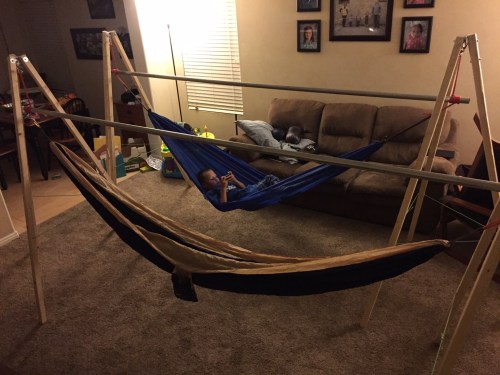
And then I stumbled across what is called a Turtle Dog Stand. Again, not so esthetically pleasing, but certainly something well within my capabilities to make.
It’s fairly light weight since it’s made with 2X2s, easily portable, and can be used outdoors:
Or set up indoors. No holes in the walls:
So, about a year ago, I went out and bought everything I needed to build one except for the connecting pole.
Then inertia set in and in the last year I’ve moved twice.
I’ve been sleeping on the air mattress I bought when the old landlords thought their sister was going to come down with them from Texas. She never did, and they never offered to pay me for it, so I figured it was mine! It’s been comfortable, but last week I heard a “POP“. when I was putting a little more air in it. It didn’t instantly deflate but while I put air in it before retiring for the night, by the time morning rolls around it’s probably lost half of the air.
Yesterday I went to the Panamanian equivalent of Lowe’s over in nearby Bugaba and bought a 10′ length of metal conduit. I wanted twelve feet, but they only sell it in 10 and 20 foot lengths. We’ll see if I can get away with the 10 footer. I didn’t want to have to throw away 8 feet of conduit if I didn’t have to.
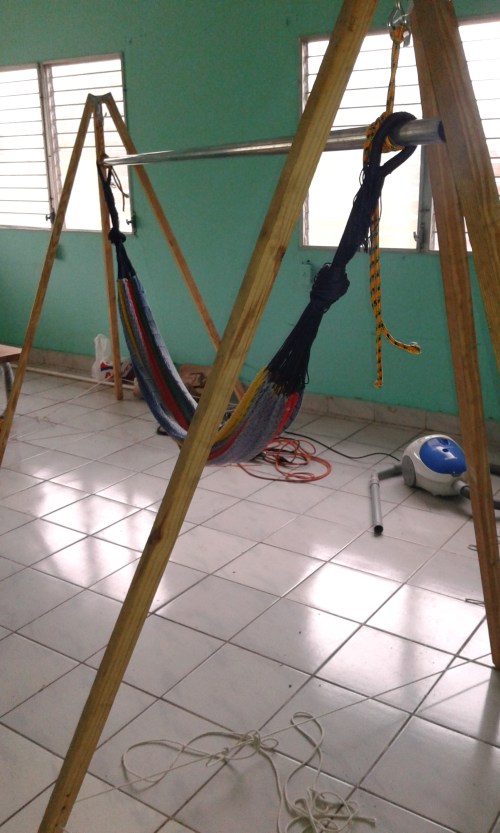
Today I put it together. Took me a couple of hours because my COPD bothered me being bent over so much. But anyway, here it is.
I had to shorten it up a bit tying the ends to make it fit the 10 foot length but it’s fine. I’ll let you know how well I slept in it tomorrow.
I’m a sailor deep down in my soul. Growing up on Cape Cod we had three boats in my family. The one that got me hooked on the water wasn’t a sailboat, though. It was an 8-foot pram my dad built in the basement of our house in Watertown, Mass., one winter and that we took down to Nickerson State Park in Brewster where we spent the entire summer. To go anywhere with it I either had to row it or use the little, cantankerous 2hp Sears and Roebuck engine. Later, when we had moved to a house in Orleans we had two sailboats: an O’Day Daysailer and an O’Day Sunfish type board boat. Those are what I learned to sail on.
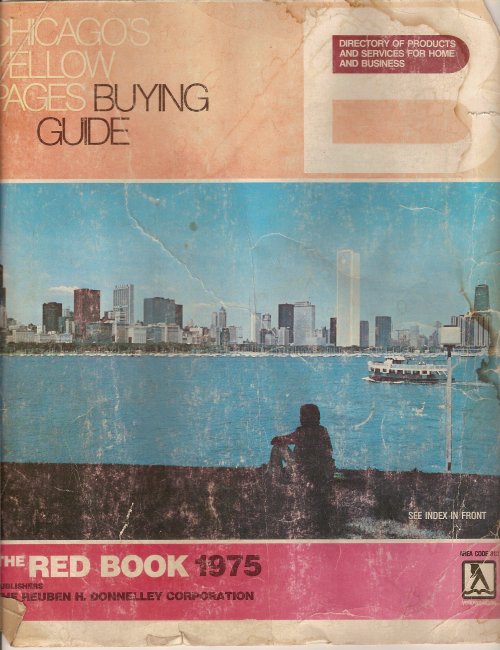
When I turned 30 I left the corporate world. I had been a newspaper reporter, a magazine editor, an advertising copywriter and a hospital public relations hack. I also wrote a couple of dozen free-lance magazine articles for national, but little known magazines like Rx Sports and Travel. I got a job as a deckhand on a dinner cruise boat in Ft, Lauderdale, following my muse, as it were. For the next 25 years I worked on a variety of boats both yachts and commercial craft. I ran a 300-passenger sight-seeing boat in Chicago in ’75 and ’76….
I worked almost exclusively on power boats including a short stint as mate on a tug boat in the Mississippi River delivering fuel and oil to ships and tugs from New Orleans to Baton Rouge. The only sailboat interludes were helping a young couple bring their 51-foot sailboat from Chicago to Ft. Lauderdale via the Illinois and Mississippi Rivers, crewing on a 65-foot ketch in the first two Ft, Lauderdale to Key West races and then a three and a half year gig as captain of an 85-foot, custom built sailboat over on the French Riviera and bringing it back to the U.S. in ’91.
Then I bought my beloved and much missed Nancy Dawson and made a 9-month single-handed trip from Ft. Lauderdale to Mexico, Belize and the Rio Dulce in Guatemala and lived on her for nearly 6 years….
As readers of this blog know, I’m going to be repatriating to the States soon because of health problems, and while the quality of health care is probably equal to the States, here it’s on a pay-up-front basis if you have to get hospitalized. It’s impossible for a 74-year-old guy with COPD and three stents in his arteries to get health insurance here. But one of the smart things I did when I moved to Panama was to continue paying my Medicare premiums just in case I had to go back. (One of the few smart decisions in my life.)
The only way that I can survive living in the States is to avoid renting an apartment somewhere and paying utilities, etc. since I’m depending on my SS to keep me alive. Here in Panama the most I’ve paid in rent was for an entire, fully-furnished small house WITH air conditioning and with paying a neighbor to maintain the yard I paid $205/month. Electricity was negligible. The highest bill I ever had here in Panama was just $30 and change. In the States my half of the 2/2 duplex was $600/month and electricity was ALWAYS $125 or MORE each month!
The only way I can survive in the States is if I buy a small boat and live “on the hook” as they say and avoid paying dockage as much as possible. I’ve had several conversations with my friend, Stef, in Lauderdale. He’s as knowledgeable about boats as anyone I know. We both have years of boat repair and restoration work under our belts. Probably an aggregate of three-quarters of a century between us. He said he’d be on the lookout for a sailboat in the size range I want, 23-25 feet, and, naturally, I’m looking, too.
Well, today I was looking on Craig’s List to see what’s available in the way of small outboard engines that would be available if the boat we liked didn’t come equipped with an engine. Of course, I’m thinking of sailboats, and one thing they do is move with the wind and use the engines when there’s none. Since I’d be using the boat almost exclusively on inland waters, rivers and the Intracoastal waterways, the sails would only be used occasionally when the wind was just right and most of the time I’d be under power.
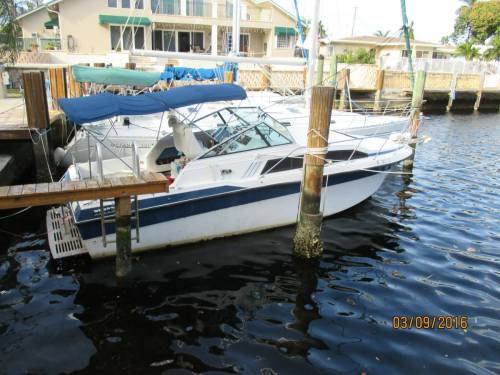
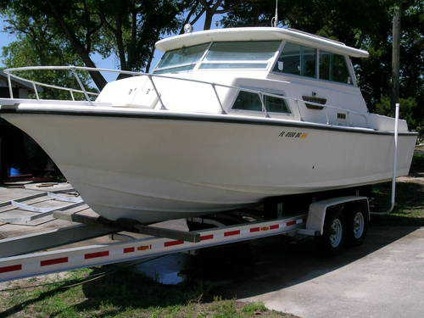
So, as I’m running through the listings I came across THIS boat. A 26-foot Wellcraft.
That’s right! It’s NOT a sailboat, but they’re only asking $2k for the 26-footer, and they claim the engine runs fine. ¿Quién sabe? But I think it’s worth looking at. Why?
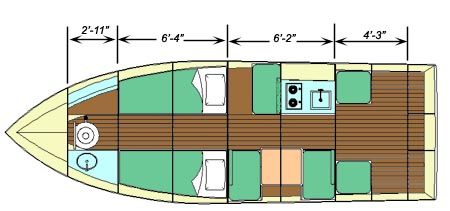
Well, for one thing a 26-foot power boat has more living space than a 26-foot sailboat. How come, you might ask? Because the power boat carries its beam almost all the way from the transom to the bow while a sailboat’s transom is narrower than the beam amidships and from there forward it pinches down rapidly to a sharp point. In other words, in an equal length a powerboat has more VOLUME than a sailboat and volume translates into living space. Let me illustrate using these two boats. The sailboat is a Columbia 26. A fine boat that anyone would be proud to own. You can see that the broadest part of the beam is amidships tapering both bow and stern. The powerboat is a Down East 25 and you can see IT has more livable space than the sailboat….
In his later years my dad had several power boats. One was a 26-foot Stamas. It looked like this, if memory serves….
He didn’t live on it full-time, but when my mom died in ’76 he took their two miniature poodles and disappeared for six months. No one knew what had happened to him. Turns out he left Venice, Florida, cut across the state on the Okeechobee Waterway, hung a left and went up into the St. John’s river to do his mourning.
I also saw another power boat, a 25-foot Tiara with an asking price of only $1,800. It’s rougher than the Wellcraft and it doesn’t have a motor. It could probably be picked up for around a grand but certainly not more than $1,200. So, what would I do for an engine? Pick up a big outboard which is what it probably had on it a long time ago judging from THIS. A bracket….
There are some other advantages to having a powerboat, especially if it has an engine with an alternator. That will keep the batteries topped off better than just a solar array which I intend to have on any boat I own.
These boats have a lot going for them in terms of livability, but while I’m a sailor at heart I need to keep my options open.
One good thing about these small power boats is that they need very little water to float in, unlike my Nancy Dawson that needed a minimum of five feet to stay afloat. These you can run the bow right up onto the beach and step off onto dry land or, at worst, ankle deep water. I STILL want to cover all of the waterways mentioned in previous posts so I’ll still be anchoring most of the time, coming into marinas to fuel up, buy groceries and wash clothes. But if I’d want to hole up at a marina somewhere for the winter I’ve found a few good places. There’s one in Steinhatchee, Florida up where the Panhandle starts trending westward. With a 26-foot boat I can rent a slip with electricity for just under $200/month, which is what I’ve been paying for rent here.
I’m not sure how to go about this, but I’m probably going to have to shift gears away from the whole idea of getting a boat and traveling around on the waterways. At least a boat large enough to live on.
This morning (Sunday, June 5th) I had a long talk with my good friend and former business partner in Fort Lauderdale. About a year ago Stef suggested I return to the States and we’d look for a boat etc., it’s all outlined in previous posts. Several of the subjects we talked about have been nagging at the back of my mind through all my writing and mental masturbation about sailing around the inland waterways of the U.S. The main concern was that with the seriousness of my COPD how was I going to deal with such chores as raising the anchor(s), raising the mast, raising the sails? The short answer is I don’t have a friggin’ clue! And I mentioned several times in my posts that I wasn’t sure if I’d be physically able to do what was needed.
I’d hoped that where Stef was living would be a place where I could build a dinghy and do what needed to be done to get the boat ready to be lived on. Well, alas, it’s NOT! And I don’t know anyone else who would have the facilities where I’d be able to do what I need to. Stef has always been pushing me to get a boat bigger than I think I’d want, and one of the problems with boats is the living area. Between half and a third of a sailboat’s length is taken up by the cockpit. Sure, you can put up a Bimini top, and the smaller boats have a “pop up” cabin top for additional headroom but mostly it’s inadequate even then.
So, is there an alternative? Yes, and I’ve toyed with the idea though I haven’t voiced it in any of my online forums…LIVING IN A VAN DOWN BY THE RIVER!
While both Stef and I are skilled at boat repair and restoration, he more than me, but I’m adequate, one thing Stef has beaucoup experience at is mechanics. He used to have a small chain of Volkswagen engine rebuild shops in New York years ago. If you brought the car in by 8 in the morning you could drive it home that evening with a rebuilt engine.
Now, I didn’t know this even after I’d known him for several years and had worked with and for him all that time. How I came to find out is a good story…
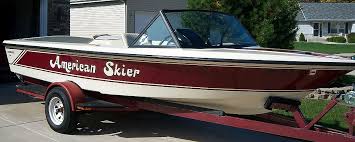
After I returned to the States after four years abroad in France, Spain, Mexico, Belize and Guatemala, I looked Stef up at his house. We were both at loose ends without work and little money. He had an American Skier (that’s a make) boat in his carport. I suggested that we paint the thing and split the proceeds. (This is NOT the boat but one just like it down to the name on the side.)
“The engine’s shot,” he said. “Doesn’t run.” Then he was silent for a couple of minutes and said, “Come on over here around 7:30 tomorrow morning.”
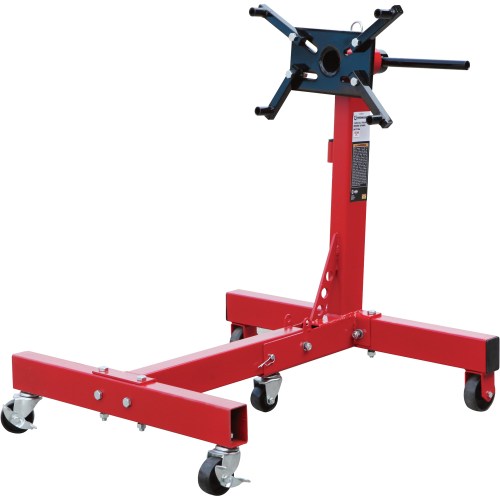
When I got there he had a table set up of a 4X8 sheet of plywood sitting on a pair of saw horses. There was an electric motor on a pedestal stand that had a large wire wheel on it and he had a couple of things I’d never seen before and didn’t know what they were. One was an engine stand…
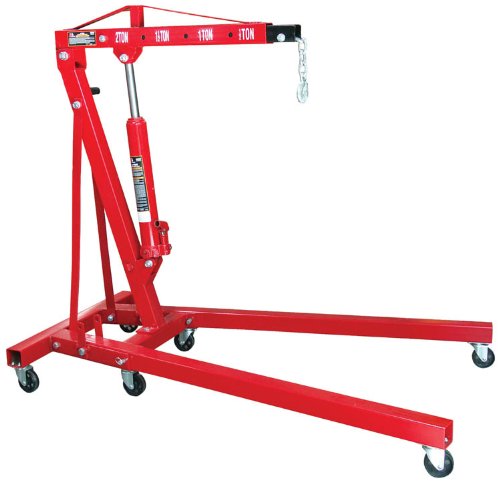
And an engine hoist.
He had already uncoupled the engine from the shaft coupling before I showed up. In about 15 minutes the engine was hooked up to the hoist and lifted out of the boat. In another 15 minutes it was mounted on the stand.
What he did next left me scratching my head. He started to dismantle the engine and throwing parts seemingly helter skelter into a couple of five-gallon plastic buckets.
Just in case you forgot what one looks like…
Freaked me out!!! I would have been putting everything in some kind of order on the table, but NOOOOO! The only things he put in an orderly fashion on the table were the eight pistons. When there was nothing but a the empty engine block on the stand he wiped his hands and said “Now, I’m going to go to Engine Rebuilders Warehouse for parts. While I’m gone,” he kicked one of the buckets, “take the bolts and clean them up on that wire wheel. I’ll be back in a little while.”
When he returned he got out a drill motor and fitted a cylinder hone into it and showed me how to ream out the cylinders. While I was doing that Stef began sorting out the clean bolts and arranging them by size on the table. He then put new rings on the pistons and after wiping the cylinders out with a clean rag began to replace the pistons into the block. And he was doing all this without any manual!!! New bearings went on everything that needed them.
When it came time to start bolting things together he went into his house and finally came out with a manual. He used it to get the torque specs, and over the next several years when we rebuilt a few dozen engines, mostly Chevy 350s, he ALWAYS went to the manual for the torque specs. He NEVER relied on his memory.
Around 4:30 that afternoon the engine was back in the boat and reconnected to the propeller shaft and a battery. Stef turned the ignition key, pushed a chrome button and VARRRRRRROOOOOM!!! MAGIC!!!
What I’m coming around to here is that it really wouldn’t matter if a van I was interested in had a bum engine or not. Simply rebuild the thing and start off with ZERO MILES on it. At the very least we’d be able to replace such things as wheel bearings and service the brakes.
One thing about this possibility is that I’ve always wanted to see the Grand Canyon. Can’t do that in a boat. I have a good friend who owns a house in Kentucky that I could go visit and crash with for a little while. We’d been “roomies” before. I could build a simple, silly boat like a Puddle Duck Racer Goose (12-feet long) build it with a minimalist cabin and then put it on a small trailer and tow it up to Minneapolis and run down The River to Mobile in it. Doing it on a 12-foot boat would certainly generate some media attention, I’m sure. My brother David’s wife lived in Minneapolis for years and I’m sure I could get her to talk one of her friends into letting me store the van at their house while doing the trip.
I could always head into Mexico in the winter. After all, I already know the language.
¿Quién sabe? In a lot of ways this is actually more “DO-ABLE.”
No matter what boat I end up buying I’m going to modify the mast. Make it shorter and make it easy to lay down and raise easily so I duck under bridges as I cruise the inland waterways. For example, the mast of a Catalina 22 is 29’1″. It would be scary trying to creep under a 30-foot bridge with less than a foot of clearance. A breezy chop or the wake from a slow-moving nearby boat could easily have you nailing the underside of the bridge.
Between Ft. Lauderdale’s inlet and the one in West Palm Beach, roughly 40 miles, there are 19 bridges. There are only two that don’t present a problem: Lauderdale’s 17th Street bridge at 55′ and the Lake Worth Bascule Bridge at 35-feet. The Linton Blvd. Bascule Bridge in Boca Raton has a clearance of 30-feet and you’d have your heart in your throat trying to creep under it.
It’s not so bad going down the 24 miles to Government Cut in Miami. There are only 11 bridges. Two of them, N.E. 192nd Street Bridge at 65-feet and the Julia Tuttle at 55-feet are no problem. The Sunny Isles bridge at 30-feet is one of the “iffy” ones. So that means there are eight bridges you have to wait to have opened for you and ALL of them have specific opening times. Of the 30 bridges between Government Cut in Miami and West Palm Beach Inlet that 22-foot sailboat you’d have to wait for 26 of them to open so you could continue on your journey. And if you weren’t at the bridge for a scheduled opening time you’d have to circle around for up to a half hour to get through. So, if you’re planning to take a trip to Peanut Island in WPB from Ft. Lauderdale in a boat that’s going to plod along at about 6 mph, at best, even if you hit every bridge opening perfectly, an impossibility, you’re looking at a VERY long day.
The solution, of course is being able to raise and lower your mast so you can creep under almost all the bridges you’re ever going to encounter. But raising and lowering the mast of a even a Catalina 22 and similar boats that have shrouds is NOT an easy thing to do no matter HOW MUCH the builders tout the simplicity of THEIR boats.
Does this look simple to you?
Not only that, but I don’t want to have a mast that’s longer than the boat itself…
My idea is to build a mast tabernacle. I’d want it high enough so that when the mast is lowered the mast would clear the pilot house I’d eventually like to build.
From a Facebook response to a previous mention of this people have written saying, “MY boat has a tabernacle” and then they send a picture of something like THIS…
Well, technically they’re correct, it IS a tabernacle but THIS is more along the lines of what I’m thinking of…
Lowered it would look like this…
AND I’d want to add some weight to the bottom of the mast, like this one, to counterbalance the whole lot and make raising and lowering an easy one-man task.
With an arrangement like the two boats above you’d be able to clear nearly every bridge you meet. And think about this…during thunderstorms lightning strikes the highest thing around, and if you’re on a sailboat the highest thing around is YOUR MAST! Wouldn’t it be great if you could quickly and easily lower the mast making you less of a target? You might say, “But I’m out sailing, I CAN’T lower my mast.” But I’m generally going to be on inland waterways so as a storm approaches I can duck into shallower water somewhere, drop anchor, lower the mast, wait it out in the comfort of the cabin.
I want an unstayed mast and will go for either a junk rig or a balanced lug. I won’t be carrying as much square footage, that’s for sure, but when I am using the sails it will be with the wind abeam, on the quarter or dead astern. No more beating into the wind. God invented engines to allow boats to do that. The “auxiliary power” on MY boat will be the sails, NOT the engine.












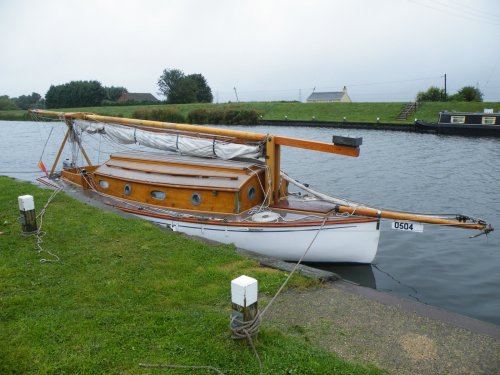

 One More Good Adventure